
How Should Singapore SME Owners Adjust Their Accounting & Tax Strategy After the MAS Monetary Policy Statement (Jan 2026)?
How Should Singapore SME Owners Adjust Their Accounting & Tax Strategy After the MAS Monetary Policy Statement (Jan 2026)?
Outline
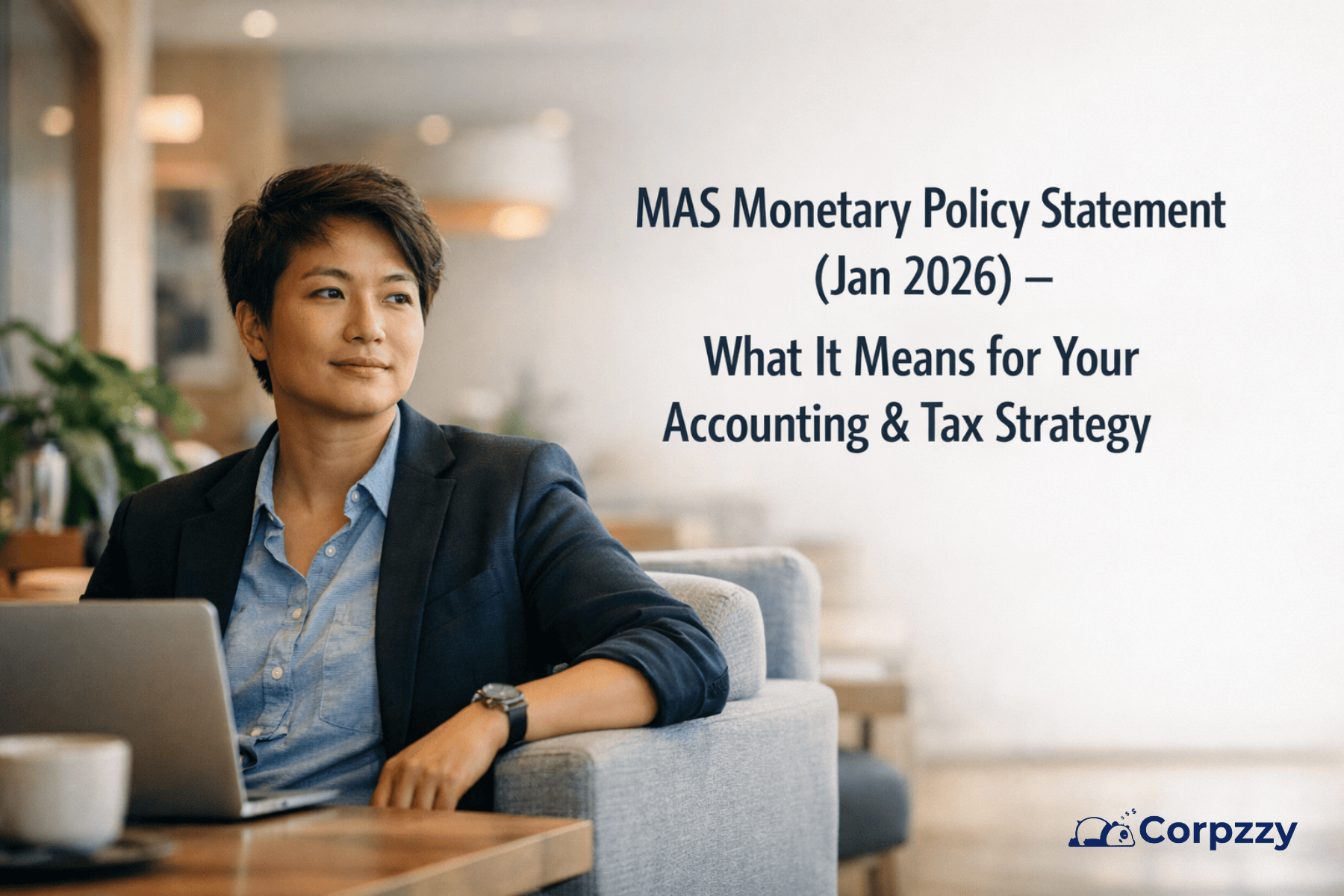
The MAS monetary policy 2026 update matters to SMEs even if you never trade currencies or take big loans. MAS uses the Singapore dollar (SGD) exchange rate as its main policy tool, and its signals can flow into your real-world numbers: customer pricing, supplier costs, FX gains/losses, borrowing costs, cash flow timing, and even how confidently you can forecast profit and tax for 2026–2027.
For many founders, the stress comes later—when the year-end accounts are finalised and you realise margins moved, FX swings weren’t tracked, or GST positions were guessed instead of planned. A clear bookkeeping system and management accounts that reflect policy-driven changes early can keep your decisions predictable. Corpzzy typically supports SMEs by translating macro updates into practical accounting routines, tax planning calendars, and compliance habits that are easy to maintain through the year.
What does the MAS policy statement really change for SMEs in 2026?
MAS (Monetary Authority of Singapore) primarily manages inflation and economic stability through the SGD exchange rate rather than changing a domestic “policy interest rate” the way some other central banks do. In practice, the Jan 2026 statement is less about “headlines” and more about the direction of travel for:
- SGD exchange rate impact: where the SGD may trend within the MAS policy band
- Imported cost pressure: many SMEs buy goods/services priced in USD, EUR, RMB, MYR, or IDR
- Financing conditions: local borrowing costs can still shift due to global rates and market expectations
- Planning confidence: your ability to set pricing, budgets, and tax provisions
MAS uses the exchange rate channel—so your cost base can move first
Even for Singapore-focused businesses, supplier pricing often includes FX effects (directly or indirectly). If your expenses are FX-linked and your sales are SGD-fixed, your margin can compress quietly.
Accounting is where the impact becomes visible (or gets missed)
Policy signals usually don’t break your business overnight. But they do create small monthly variances. Those variances become big at year-end if you don’t:
- record FX transactions cleanly
- reconcile foreign currency balances
- separate operational margin changes from FX noise
- update budgets and tax provisions during the year
This is why Singapore SME accounting that is policy-aware is less about “perfect books” and more about running the business with fewer surprises.
How does MAS monetary policy 2026 affect your pricing and revenue recognition decisions?
Pricing decisions often lag behind FX and cost movements. The risk is that you keep “last year’s prices” while your landed costs, subscriptions, or overseas contractors become more expensive.
If you sell in SGD but buy in foreign currency
Common examples:
- F&B importing ingredients in USD
- e-commerce buying inventory in RMB
- tech SMEs paying overseas developers in MYR/IDR/USD
Practical accounting actions:
- Track gross margin monthly, not just at year-end
- Break down COGS into FX-linked vs non-FX-linked components
- Maintain a simple “FX sensitivity” note: e.g., “Every 1% USD/SGD move changes monthly costs by ~$X”
If you invoice customers in foreign currency
If you bill in USD/EUR, your SGD revenue can vary even when sales volumes are stable.
Accounting points to get right:
- Ensure invoices record the invoice currency and FX rate source consistently
- Identify whether you have FX gains/losses from settlement timing
- Review contract terms: do you allow repricing if FX moves beyond a threshold?
Revenue recognition: don’t let FX confusion create “false growth”
Some SMEs see higher SGD revenue due to FX translation and assume business improved. But if your costs moved similarly (or more), profit may not follow.
A simple management report that separates:
- volume/price effect (real performance)
- FX translation effect (currency movement)
helps founders make calmer decisions.
What should SMEs do about FX and hedging for SMEs—do you really need it?
Many SMEs assume hedging is “only for big companies.” In practice, FX and hedging for SMEs can be lightweight. The goal is not to speculate; it’s to make costs and cash flow more predictable.
Start with a 3-level approach (before you buy any hedging products)
- Natural hedging: match currency inflows with outflows where possible
- Operational hedges: adjust pricing terms, shorter quote validity, partial deposits
- Financial hedges: simple forward contracts (subject to bank approval and suitability)
When hedging may be worth considering
Typically, SMEs explore hedging when:
- FX-linked costs are a large share of monthly expenses
- sales contracts have fixed SGD pricing for long periods
- project margins are thin and FX can wipe them out
- there is a long gap between quotation and payment
Accounting setup matters before hedging
If you hedge but your books cannot track exposures, you may create more confusion.
Practical checklist for your accounting team/bookkeeper:
- Maintain supplier/customer ledgers by currency
- Revalue foreign currency balances consistently at month-end
- Label transactions as: operating, financing, FX-only items
- Keep a simple exposure schedule: payables/receivables by currency and due date
Corpzzy often helps SMEs implement these routines as part of predictable monthly or quarterly closes—so founders can decide on hedging with real numbers, not guesses.
How will the SGD exchange rate impact show up in your financial statements?
FX doesn’t only affect “big” importers. It shows up quietly in several places.
Profit & Loss: FX gains/losses can distort operating performance
Typical scenarios:
- You buy inventory in USD, pay 30–60 days later, and SGD moves in between
- You hold USD in a multi-currency account and revalue at month-end
Result:
- You might record unrealised FX gains/losses (paper movements)
- You might record realised FX gains/losses when you settle
Management tip:
- Review operating profit before FX as a separate line, so you can see the business trend.
Balance Sheet: foreign currency balances need consistent revaluation
If you have:
- foreign currency bank balances
- foreign currency receivables/payables
they usually need revaluation at reporting dates using a consistent approach. If this is missed, year-end accounts can swing unexpectedly.
Cash Flow: FX affects timing, not just totals
Even if annual profit is fine, FX-driven cost increases can create monthly cash squeezes.
This is why a simple 13-week cash forecast (updated monthly) becomes more useful in 2026—especially for SMEs with import cycles or overseas payroll.
How should cash flow and interest costs planning change after MAS Jan 2026 signals?
Even though MAS works through the exchange rate, SME borrowing costs can still move due to:
- global interest rate environment
- bank funding costs and risk appetite
- market expectations after major policy signals
So cash flow and interest costs deserve a more active plan in 2026.
Map your debt exposure in plain terms
List each facility and note:
- fixed vs floating rate
- repricing frequency (monthly/quarterly)
- covenants (if any)
- security pledged
Update your cash forecast to include “rate and FX shocks”
A practical step:
- Add a scenario line: “+0.5% interest cost” or “USD strengthens by 2%”
- See if you still meet payroll, rent, and tax instalments comfortably
Common mistake: mixing loan principal with expenses
Founders sometimes treat loan repayments as “expenses” in a way that confuses profitability.
Good bookkeeping separates:
- interest expense (P&L)
- principal repayment (cash flow)
This improves decision-making on pricing and cost cuts.
What does MAS monetary policy 2026 mean for SME tax and GST planning?
MAS policy does not directly change tax law. But it can change your numbers, and your numbers determine your tax and GST outcomes.
Corporate income tax: plan your tax provision earlier
If FX or interest costs are moving, your profit forecast can change.
Practical approach:
- Review management accounts quarterly
- Update expected full-year profit range
- Set aside tax cash conservatively to avoid a year-end scramble
GST planning: watch your pricing, place of supply, and registration thresholds
GST rules can be technical, but the planning is practical:
- If revenue is growing because of FX translation or price updates, monitor whether you approach GST registration thresholds (as applicable under current IRAS rules; thresholds and timelines may change)
- If you sell services cross-border or buy digital services from overseas, confirm how GST applies in practice
- Keep clean documentation for zero-rated supplies (where relevant)
Common mistake: treating GST as “extra money”
GST collected is not revenue. In tighter cash conditions, SMEs sometimes spend GST cash and struggle later.
A simple discipline:
- Keep a separate GST buffer account or tracked reserve
- Reconcile GST quarterly (or monthly if transaction-heavy)
This is a core part of SME tax and GST planning that reduces stress.
How can Singapore SME accounting be made “policy-aware” without becoming complicated?
You don’t need an economist on staff. You need a reporting rhythm that picks up FX and cost shifts early.
Set a monthly close routine that founders can actually use
A lightweight monthly pack might include:
- P&L with gross margin
- FX gains/losses line separated
- top 10 payables by currency
- cash balance and 13-week cash forecast
- AR ageing and top overdue customers
Use consistent FX rate sources and cut-off rules
Pick a practical policy:
- invoice date rate vs settlement date rate (and how you record differences)
- month-end revaluation approach
- documentation for audit trails
Consistency matters more than “perfect” FX timing.
Don’t wait for year-end to discover the story
A common founder pattern is:
- do bookkeeping late
- file tax based on historicals
- then react when cash gets tight
A policy-aware accounting workflow prevents that by turning MAS “macro” into monthly operational signals.
What founder mistakes become more costly in 2026–2027 if FX and rates stay uncertain?
When macro conditions are calm, messy admin can still “work.” When FX and financing costs move, the same mess becomes expensive.
Mistake 1: Quoting long-validity prices without FX clauses
If your quotes stay valid for 60–90 days but suppliers reprice weekly, your margin becomes a gamble.
Fix:
- shorten quote validity
- require deposits for FX-heavy orders
- consider currency-adjustment clauses for large projects
Mistake 2: No clear separation between business and personal spending
This makes it harder to understand real cost inflation and can create tax filing stress.
Fix:
- separate bank accounts
- clear reimbursement rules
- consistent expense categorisation
Mistake 3: Ignoring foreign currency balances until year-end
Unreconciled multi-currency accounts are a common source of last-minute adjustments.
Fix:
- monthly reconciliation
- track realised vs unrealised FX
Mistake 4: Treating compliance deadlines as “later problems”
Late or messy filings can distract founders exactly when they need focus for pricing and cash flow.
In practice, founders benefit when corporate secretarial calendars (AGM/AR/registers where applicable) and accounting calendars are aligned—so nothing piles up at once.
What should founders prepare now to stay compliant and flexible through 2026?
The most practical “Jan 2026 action” is to make sure your financial information is timely enough to respond.
A 2026 readiness checklist for SMEs
Accounting & reporting
- Monthly or quarterly close schedule confirmed
- Multi-currency bank accounts reconciled monthly
- Margin tracking by product/service line
- Simple FX exposure schedule (by currency and due date)
Tax & GST
- Profit forecast updated at least quarterly
- Tax cash buffer set aside
- GST reconciliation routine established
- Cross-border invoices reviewed for GST treatment (where relevant)
Cash flow & financing
- 13-week cash forecast maintained
- Loan terms summarised (fixed/floating, repricing)
- Scenario planning for FX and interest shifts
Corporate compliance hygiene
- Key dates tracked for annual returns and registers
- Director/resignation/appointment changes documented promptly
- Share issuances/transfers properly recorded
If you’re a foreign founder relocating to Singapore, work pass planning may also affect payroll, director arrangements, and timing. In practice, MOM assessment is case-by-case, so it helps to align staffing and compliance timelines early.
Corpzzy typically supports founders by setting up a predictable compliance cadence—so you can focus on decisions, not paperwork.
How do you turn the MAS statement into a practical 90-day finance plan?
Instead of trying to “predict the SGD,” treat MAS monetary policy 2026 as a prompt to tighten execution.
Step 1: Reprice or re-quote where your margin is most FX-sensitive
Identify:
- top 20% of products/services driving profit
- suppliers invoicing in foreign currency
- contracts with long lead times
Update:
- quote validity
- deposit terms
- pricing review frequency
Step 2: Clean up your chart of accounts for decision-making
Small changes help:
- separate bank charges and FX differences
- tag costs as “FX-linked” where practical
- track interest expense clearly
Step 3: Build one simple dashboard for founders
A one-page view, updated monthly:
- revenue, gross margin, operating profit
- FX gains/losses
- cash runway (months)
- overdue receivables
- tax/GST set-aside balance
Step 4: Decide your hedging stance (none / light / structured)
Document a policy you can follow:
- when you hedge
- what instruments you allow
- who approves
- how you record it
The goal is a lifestyle-friendly finance rhythm: fewer surprises, fewer “urgent” fixes, and clearer trade-offs.
Conclusion
MAS updates can feel distant, but the impact on SMEs is usually very local: costs, pricing, cash flow, and the confidence to plan tax and GST without last-minute stress. For 2026–2027, the practical advantage comes from timely books, clean multi-currency tracking, and simple management accounts that separate operating performance from FX noise.
Founders who prepare now—by tightening monthly closes, documenting FX exposure, and stress-testing cash flow and interest costs—tend to make calmer decisions even when the environment shifts. For those who want a clear, predictable compliance and reporting cadence as they plan through 2026, Corpzzy can be a steady partner in turning policy signals into practical accounting and tax routines.
Frequently Asked Questions
Questions? We Have Answers
Related Business Articles
Share This Story, Choose Your Platform!

The MAS monetary policy 2026 update matters to SMEs even if you never trade currencies or take big loans. MAS uses the Singapore dollar (SGD) exchange rate as its main policy tool, and its signals can flow into your real-world numbers: customer pricing, supplier costs, FX gains/losses, borrowing costs, cash flow timing, and even how confidently you can forecast profit and tax for 2026–2027.
For many founders, the stress comes later—when the year-end accounts are finalised and you realise margins moved, FX swings weren’t tracked, or GST positions were guessed instead of planned. A clear bookkeeping system and management accounts that reflect policy-driven changes early can keep your decisions predictable. Corpzzy typically supports SMEs by translating macro updates into practical accounting routines, tax planning calendars, and compliance habits that are easy to maintain through the year.
What does the MAS policy statement really change for SMEs in 2026?
MAS (Monetary Authority of Singapore) primarily manages inflation and economic stability through the SGD exchange rate rather than changing a domestic “policy interest rate” the way some other central banks do. In practice, the Jan 2026 statement is less about “headlines” and more about the direction of travel for:
- SGD exchange rate impact: where the SGD may trend within the MAS policy band
- Imported cost pressure: many SMEs buy goods/services priced in USD, EUR, RMB, MYR, or IDR
- Financing conditions: local borrowing costs can still shift due to global rates and market expectations
- Planning confidence: your ability to set pricing, budgets, and tax provisions
MAS uses the exchange rate channel—so your cost base can move first
Even for Singapore-focused businesses, supplier pricing often includes FX effects (directly or indirectly). If your expenses are FX-linked and your sales are SGD-fixed, your margin can compress quietly.
Accounting is where the impact becomes visible (or gets missed)
Policy signals usually don’t break your business overnight. But they do create small monthly variances. Those variances become big at year-end if you don’t:
- record FX transactions cleanly
- reconcile foreign currency balances
- separate operational margin changes from FX noise
- update budgets and tax provisions during the year
This is why Singapore SME accounting that is policy-aware is less about “perfect books” and more about running the business with fewer surprises.
How does MAS monetary policy 2026 affect your pricing and revenue recognition decisions?
Pricing decisions often lag behind FX and cost movements. The risk is that you keep “last year’s prices” while your landed costs, subscriptions, or overseas contractors become more expensive.
If you sell in SGD but buy in foreign currency
Common examples:
- F&B importing ingredients in USD
- e-commerce buying inventory in RMB
- tech SMEs paying overseas developers in MYR/IDR/USD
Practical accounting actions:
- Track gross margin monthly, not just at year-end
- Break down COGS into FX-linked vs non-FX-linked components
- Maintain a simple “FX sensitivity” note: e.g., “Every 1% USD/SGD move changes monthly costs by ~$X”
If you invoice customers in foreign currency
If you bill in USD/EUR, your SGD revenue can vary even when sales volumes are stable.
Accounting points to get right:
- Ensure invoices record the invoice currency and FX rate source consistently
- Identify whether you have FX gains/losses from settlement timing
- Review contract terms: do you allow repricing if FX moves beyond a threshold?
Revenue recognition: don’t let FX confusion create “false growth”
Some SMEs see higher SGD revenue due to FX translation and assume business improved. But if your costs moved similarly (or more), profit may not follow.
A simple management report that separates:
- volume/price effect (real performance)
- FX translation effect (currency movement)
helps founders make calmer decisions.
What should SMEs do about FX and hedging for SMEs—do you really need it?
Many SMEs assume hedging is “only for big companies.” In practice, FX and hedging for SMEs can be lightweight. The goal is not to speculate; it’s to make costs and cash flow more predictable.
Start with a 3-level approach (before you buy any hedging products)
- Natural hedging: match currency inflows with outflows where possible
- Operational hedges: adjust pricing terms, shorter quote validity, partial deposits
- Financial hedges: simple forward contracts (subject to bank approval and suitability)
When hedging may be worth considering
Typically, SMEs explore hedging when:
- FX-linked costs are a large share of monthly expenses
- sales contracts have fixed SGD pricing for long periods
- project margins are thin and FX can wipe them out
- there is a long gap between quotation and payment
Accounting setup matters before hedging
If you hedge but your books cannot track exposures, you may create more confusion.
Practical checklist for your accounting team/bookkeeper:
- Maintain supplier/customer ledgers by currency
- Revalue foreign currency balances consistently at month-end
- Label transactions as: operating, financing, FX-only items
- Keep a simple exposure schedule: payables/receivables by currency and due date
Corpzzy often helps SMEs implement these routines as part of predictable monthly or quarterly closes—so founders can decide on hedging with real numbers, not guesses.
How will the SGD exchange rate impact show up in your financial statements?
FX doesn’t only affect “big” importers. It shows up quietly in several places.
Profit & Loss: FX gains/losses can distort operating performance
Typical scenarios:
- You buy inventory in USD, pay 30–60 days later, and SGD moves in between
- You hold USD in a multi-currency account and revalue at month-end
Result:
- You might record unrealised FX gains/losses (paper movements)
- You might record realised FX gains/losses when you settle
Management tip:
- Review operating profit before FX as a separate line, so you can see the business trend.
Balance Sheet: foreign currency balances need consistent revaluation
If you have:
- foreign currency bank balances
- foreign currency receivables/payables
they usually need revaluation at reporting dates using a consistent approach. If this is missed, year-end accounts can swing unexpectedly.
Cash Flow: FX affects timing, not just totals
Even if annual profit is fine, FX-driven cost increases can create monthly cash squeezes.
This is why a simple 13-week cash forecast (updated monthly) becomes more useful in 2026—especially for SMEs with import cycles or overseas payroll.
How should cash flow and interest costs planning change after MAS Jan 2026 signals?
Even though MAS works through the exchange rate, SME borrowing costs can still move due to:
- global interest rate environment
- bank funding costs and risk appetite
- market expectations after major policy signals
So cash flow and interest costs deserve a more active plan in 2026.
Map your debt exposure in plain terms
List each facility and note:
- fixed vs floating rate
- repricing frequency (monthly/quarterly)
- covenants (if any)
- security pledged
Update your cash forecast to include “rate and FX shocks”
A practical step:
- Add a scenario line: “+0.5% interest cost” or “USD strengthens by 2%”
- See if you still meet payroll, rent, and tax instalments comfortably
Common mistake: mixing loan principal with expenses
Founders sometimes treat loan repayments as “expenses” in a way that confuses profitability.
Good bookkeeping separates:
- interest expense (P&L)
- principal repayment (cash flow)
This improves decision-making on pricing and cost cuts.
What does MAS monetary policy 2026 mean for SME tax and GST planning?
MAS policy does not directly change tax law. But it can change your numbers, and your numbers determine your tax and GST outcomes.
Corporate income tax: plan your tax provision earlier
If FX or interest costs are moving, your profit forecast can change.
Practical approach:
- Review management accounts quarterly
- Update expected full-year profit range
- Set aside tax cash conservatively to avoid a year-end scramble
GST planning: watch your pricing, place of supply, and registration thresholds
GST rules can be technical, but the planning is practical:
- If revenue is growing because of FX translation or price updates, monitor whether you approach GST registration thresholds (as applicable under current IRAS rules; thresholds and timelines may change)
- If you sell services cross-border or buy digital services from overseas, confirm how GST applies in practice
- Keep clean documentation for zero-rated supplies (where relevant)
Common mistake: treating GST as “extra money”
GST collected is not revenue. In tighter cash conditions, SMEs sometimes spend GST cash and struggle later.
A simple discipline:
- Keep a separate GST buffer account or tracked reserve
- Reconcile GST quarterly (or monthly if transaction-heavy)
This is a core part of SME tax and GST planning that reduces stress.
How can Singapore SME accounting be made “policy-aware” without becoming complicated?
You don’t need an economist on staff. You need a reporting rhythm that picks up FX and cost shifts early.
Set a monthly close routine that founders can actually use
A lightweight monthly pack might include:
- P&L with gross margin
- FX gains/losses line separated
- top 10 payables by currency
- cash balance and 13-week cash forecast
- AR ageing and top overdue customers
Use consistent FX rate sources and cut-off rules
Pick a practical policy:
- invoice date rate vs settlement date rate (and how you record differences)
- month-end revaluation approach
- documentation for audit trails
Consistency matters more than “perfect” FX timing.
Don’t wait for year-end to discover the story
A common founder pattern is:
- do bookkeeping late
- file tax based on historicals
- then react when cash gets tight
A policy-aware accounting workflow prevents that by turning MAS “macro” into monthly operational signals.
What founder mistakes become more costly in 2026–2027 if FX and rates stay uncertain?
When macro conditions are calm, messy admin can still “work.” When FX and financing costs move, the same mess becomes expensive.
Mistake 1: Quoting long-validity prices without FX clauses
If your quotes stay valid for 60–90 days but suppliers reprice weekly, your margin becomes a gamble.
Fix:
- shorten quote validity
- require deposits for FX-heavy orders
- consider currency-adjustment clauses for large projects
Mistake 2: No clear separation between business and personal spending
This makes it harder to understand real cost inflation and can create tax filing stress.
Fix:
- separate bank accounts
- clear reimbursement rules
- consistent expense categorisation
Mistake 3: Ignoring foreign currency balances until year-end
Unreconciled multi-currency accounts are a common source of last-minute adjustments.
Fix:
- monthly reconciliation
- track realised vs unrealised FX
Mistake 4: Treating compliance deadlines as “later problems”
Late or messy filings can distract founders exactly when they need focus for pricing and cash flow.
In practice, founders benefit when corporate secretarial calendars (AGM/AR/registers where applicable) and accounting calendars are aligned—so nothing piles up at once.
What should founders prepare now to stay compliant and flexible through 2026?
The most practical “Jan 2026 action” is to make sure your financial information is timely enough to respond.
A 2026 readiness checklist for SMEs
Accounting & reporting
- Monthly or quarterly close schedule confirmed
- Multi-currency bank accounts reconciled monthly
- Margin tracking by product/service line
- Simple FX exposure schedule (by currency and due date)
Tax & GST
- Profit forecast updated at least quarterly
- Tax cash buffer set aside
- GST reconciliation routine established
- Cross-border invoices reviewed for GST treatment (where relevant)
Cash flow & financing
- 13-week cash forecast maintained
- Loan terms summarised (fixed/floating, repricing)
- Scenario planning for FX and interest shifts
Corporate compliance hygiene
- Key dates tracked for annual returns and registers
- Director/resignation/appointment changes documented promptly
- Share issuances/transfers properly recorded
If you’re a foreign founder relocating to Singapore, work pass planning may also affect payroll, director arrangements, and timing. In practice, MOM assessment is case-by-case, so it helps to align staffing and compliance timelines early.
Corpzzy typically supports founders by setting up a predictable compliance cadence—so you can focus on decisions, not paperwork.
How do you turn the MAS statement into a practical 90-day finance plan?
Instead of trying to “predict the SGD,” treat MAS monetary policy 2026 as a prompt to tighten execution.
Step 1: Reprice or re-quote where your margin is most FX-sensitive
Identify:
- top 20% of products/services driving profit
- suppliers invoicing in foreign currency
- contracts with long lead times
Update:
- quote validity
- deposit terms
- pricing review frequency
Step 2: Clean up your chart of accounts for decision-making
Small changes help:
- separate bank charges and FX differences
- tag costs as “FX-linked” where practical
- track interest expense clearly
Step 3: Build one simple dashboard for founders
A one-page view, updated monthly:
- revenue, gross margin, operating profit
- FX gains/losses
- cash runway (months)
- overdue receivables
- tax/GST set-aside balance
Step 4: Decide your hedging stance (none / light / structured)
Document a policy you can follow:
- when you hedge
- what instruments you allow
- who approves
- how you record it
The goal is a lifestyle-friendly finance rhythm: fewer surprises, fewer “urgent” fixes, and clearer trade-offs.
Conclusion
MAS updates can feel distant, but the impact on SMEs is usually very local: costs, pricing, cash flow, and the confidence to plan tax and GST without last-minute stress. For 2026–2027, the practical advantage comes from timely books, clean multi-currency tracking, and simple management accounts that separate operating performance from FX noise.
Founders who prepare now—by tightening monthly closes, documenting FX exposure, and stress-testing cash flow and interest costs—tend to make calmer decisions even when the environment shifts. For those who want a clear, predictable compliance and reporting cadence as they plan through 2026, Corpzzy can be a steady partner in turning policy signals into practical accounting and tax routines.
Frequently Asked Questions
Questions? We Have Answers
Share This Story, Choose Your Platform!