
How Will the MOM Committee of Supply 2026 EP and S Pass Salary Increases Affect Your SME Payroll Planning for 2027–2028?
How Will the MOM Committee of Supply 2026 EP and S Pass Salary Increases Affect Your SME Payroll Planning for 2027–2028?
Outline
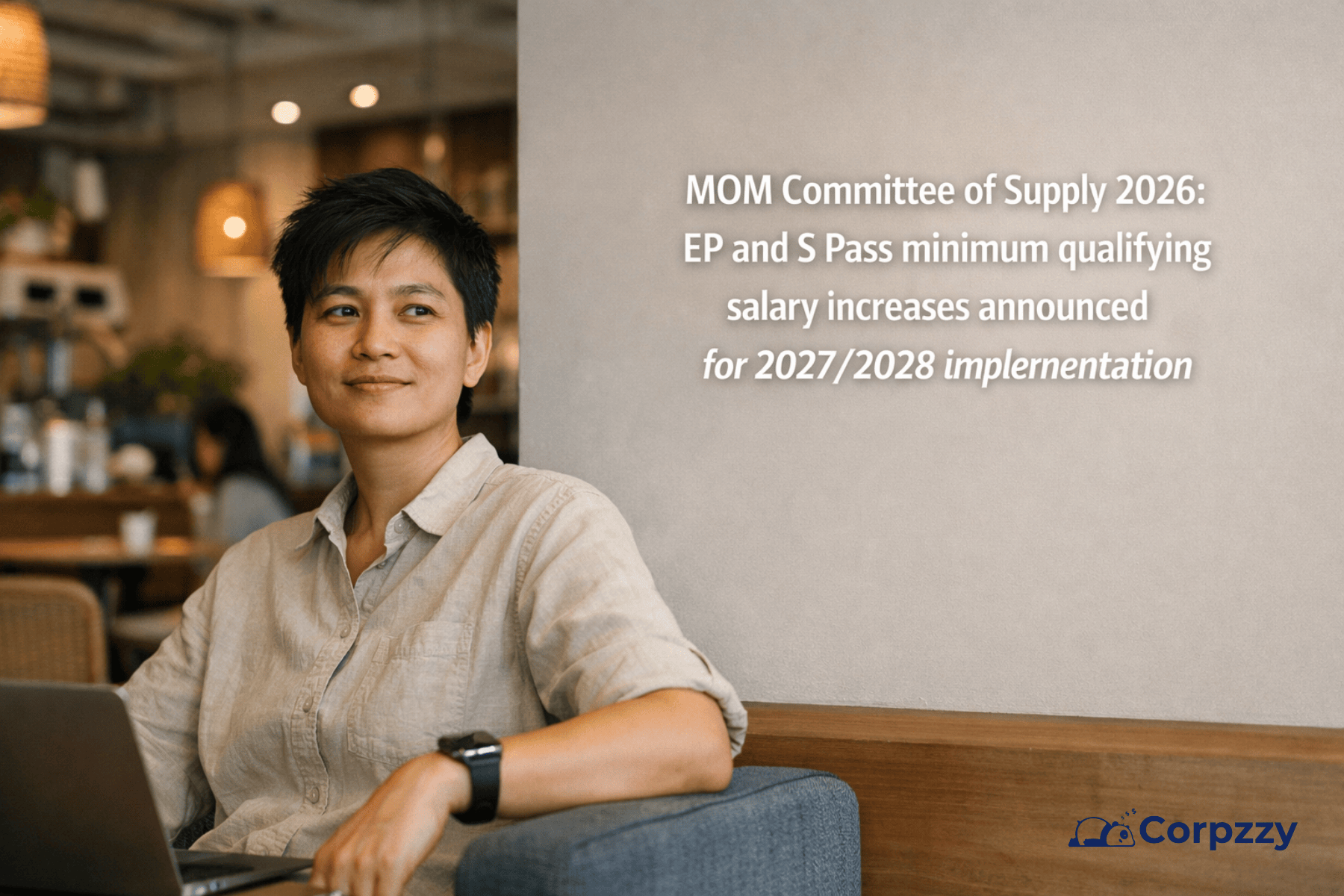
The MOM Committee of Supply (COS) 2026 announcements matter because “later” policy changes often become “next budget cycle” cashflow problems for SMEs. With the Employment Pass salary increase Singapore employers are preparing for, and the S Pass qualifying salary 2027 changes signalled for staged implementation in 2027–2028, founders have a narrow window to re-check headcount plans, salary bands, and payroll systems before the new minimums start affecting renewals and new applications. For many teams, the risk is not just higher wages—it’s unexpected top-ups, pass rejections, and messy downstream impacts on CPF reporting for locals, tax reporting, and management accounts. This guide explains what typically changes, where businesses get caught, and how to prepare in 2026 so your payroll and accounting stay predictable. Corpzzy often supports SMEs by turning these rule updates into clear, trackable payroll and compliance action plans.
What did MOM announce at Committee of Supply (COS) 2026, and why does it matter now?
MOM’s COS announcements are usually a forward signal: changes are stated early so employers can plan ahead. Even when the exact tables and details are later published, the direction is clear—minimum qualifying salaries for work passes rise over time.
For SMEs, the practical impact isn’t limited to HR. It flows into:
- SME manpower cost planning (cashflow, pricing, budgets)
- Payroll structuring (fixed vs variable pay, allowances, reimbursements)
- Hiring timelines (whether to hire in 2026 vs 2027)
- Accounting & tax for SMEs Singapore (profit forecasts, tax provisions, expense classification)
- HR compliance Singapore (documentation, contracts, consistent payslips)
If your business hires foreign professionals, the MOM EP S Pass rules change is best treated like a “known upcoming cost” rather than a surprise later.
What is an EP or S Pass ‘minimum qualifying salary’, in practical payroll terms?
The minimum qualifying salary is a baseline that MOM assesses when you apply for or renew a pass. While the fine details can differ by pass type and may be updated by MOM over time, in practice it means your offered salary must meet the relevant minimum for that pass at the time of application.
How this shows up in day-to-day operations
Even if your payroll “runs fine,” problems appear when:
- you renew a pass under a new salary table
- you convert someone from a different pass type
- you promote someone but don’t update the salary correctly in the contract
- you rely heavily on variable pay that may not be treated the same as fixed monthly salary
What counts as salary for assessment purposes?
MOM publishes guidance on what components are considered. Generally, employers should expect MOM to focus on stable, regular salary components rather than one-off items.
To plan conservatively, many SMEs treat the minimum as something the fixed monthly salary should meet, and treat variable items as a bonus—unless MOM guidance clearly allows otherwise.
Why the EP vs S Pass distinction matters
An Employment Pass is typically for foreign professionals, managers, and executives. An S Pass is typically for mid-skilled foreign employees, subject to additional controls. The qualifying salary mechanics and broader criteria differ.
That’s why a single “across-the-board raise” policy can backfire: you may need separate salary bands by role and by pass pathway.
How does the Employment Pass salary increase Singapore employers should expect affect budgeting?
Even before the exact future numbers are applied, you can budget using a scenario approach.
Scenario budgeting: the simplest way SMEs avoid shocks
Build at least three scenarios for 2027 and 2028 manpower costs:
- Base case: current wages + standard annual increment
- Policy case: base case + expected EP/S Pass minimum lift (conservative estimate)
- Stress case: policy case + additional top-ups for renewals, plus recruitment cost increases
You don’t need perfect numbers in 2026. You need a model that shows which roles become “at risk” of falling below new minimums.
Don’t forget the hidden multipliers
Salary increases can trigger:
- higher employer insurance costs (depending on coverage terms)
- higher bonus expectations to maintain internal parity
- compression between junior and senior roles
- increased recruitment market rates (especially if many employers are adjusting simultaneously)
Practical example: the renewal trap
A founder hires a foreign professional in 2026 on a package that meets 2026 requirements. In 2027, the renewal is assessed under the new minimum.
If the salary is now below the minimum, the business may:
- top up salary last minute (unbudgeted)
- restructure pay (risky if it looks artificial)
- lose the employee and restart hiring
That is why SME manpower cost planning should include “renewal-year checks” starting now.
How will S Pass qualifying salary 2027 changes affect SMEs differently from EP changes?
S Pass planning often impacts a wider range of SMEs because S Pass roles can sit in operational functions where salary bands are tighter and margins are sensitive.
Why S Pass changes can feel ‘sharper’ for SMEs
Even a moderate increase can create immediate tension when:
- the role is priced into client contracts at fixed rates
- the role is in a cost centre (e.g., internal support)
- you have multiple S Pass holders on similar bands
Watch the interaction with headcount controls
Beyond salary minimums, S Pass hiring can be affected by other policy levers (subject to changes): quota, levies, and sector rules.
Even if your salary meets the S Pass qualifying salary 2027 level, you still want to plan for the possibility that the business needs:
- a different mix of local vs foreign hiring
- training plans for local staff
- clearer job scopes to support pass assessment
Practical example: margin squeeze
A small services company employs two S Pass holders. The company can increase salaries, but the client contract renews only annually.
If the salary changes take effect before the contract reprices, cashflow tightens.
A 2026 plan can include:
- renegotiation clauses tied to regulatory cost changes
- a phased salary adjustment timeline
- a pricing review calendar aligned to pass renewal dates
What payroll items and salary structures commonly cause MOM assessment problems?
Many pass issues are not about intent; they’re about messy pay components and inconsistent documentation.
Fixed vs variable pay: where SMEs get caught
In practice, problems arise when the offered package is written as:
- low base pay + high “allowances” without clear purpose
- heavy commissions that fluctuate month to month
- one-off “top-ups” near renewal time
If the minimum is interpreted as requiring a stable baseline, a package that looks unstable may increase rejection risk.
Allowances and reimbursements: keep them clean
Common items that become confusing:
- transport allowance vs transport reimbursement
- phone allowance vs reimbursement with receipts
- ‘meal allowance’ that changes monthly
A good payroll system should clearly label items, apply consistent rules, and keep supporting documents.
Common mistake: changing job title without updating payroll records
A promotion letter says “Manager,” but the employment contract, IR8A (where relevant), and internal HR record still show an old title and pay structure.
That inconsistency can raise questions during assessments, audits, or when employees apply for housing or financing using payslips.
How do EP/S Pass salary increases affect CPF, taxes, and accounting reports (even for non-pass holders)?
EP and S Pass holders generally do not receive employer CPF in the same way Singapore Citizens/PRs do, but the ripple effects still hit your payroll and finance operations.
Management accounts: manpower cost planning needs better categorisation
If you increase foreign salaries, you should separate manpower costs clearly:
- local staff wages + employer CPF
- foreign staff wages
- bonuses and variable incentives
- recruitment and relocation costs
That way, you can see whether increased foreign wages are still cheaper than expanding local headcount when CPF is included.
Corporate tax: higher wages change profit forecasts
Wages are typically deductible business expenses when they are incurred wholly and exclusively for the business. Practically, higher wages reduce accounting profit, which affects:
- quarterly/annual profit forecasts
- tax provision planning
- dividend planning
But don’t assume “higher wages means less tax, so it’s fine.” Cash still goes out monthly.
Individual tax reporting: keep payroll records consistent
For employees, accurate year-end reporting depends on clean payroll data. Even if your team is small, you want:
- consistent payslip breakdowns
- properly classified allowances
- clear bonus periods
This is where Singapore payroll outsourcing can reduce risk—if the provider is used to local reporting norms and keeps audit-friendly records.
What should SMEs do in 2026 to prepare for 2027–2028 implementation?
Preparation in 2026 is mostly about building a timeline and removing uncertainty.
Step 1: Map your pass population and key dates
Create a simple tracker:
- employee name
- pass type (EP/S Pass)
- pass expiry / renewal window
- current fixed monthly salary
- variable components
- next expected salary review date
This immediately shows which renewals fall after the new minimums take effect.
Step 2: Build salary bands that can survive the next two years
Instead of negotiating one-off packages each time, define bands by role level.
A practical approach:
- Band A: entry-level / junior
- Band B: experienced / specialist
- Band C: lead / manager
Then link bands to:
- internal parity (local vs foreign)
- your pricing model (billable rate assumptions)
- realistic increment policy
Step 3: Decide early how you will handle top-ups
In practice, SMEs use one of these approaches:
- Annual increment aligned to renewal (predictable)
- Mid-year adjustment (if renewals cluster)
- Contract renewal with revised salary (clean documentation)
Avoid last-minute adjustments that look like temporary fixes.
Step 4: Stress-test cashflow
Run a simple monthly cashflow view for 2027 and 2028 with:
- wages at revised levels
- worst-case hiring lag (role unfilled for 2–3 months)
- recruitment fees
The point is not to predict perfectly, but to see whether you need:
- higher working capital buffer
- price increases
- slower hiring plan
Step 5: Clean up payroll mechanics now
If your payslips are inconsistent, or you process payroll manually, 2026 is a good time to:
- standardise pay codes (basic, allowance, reimbursement, bonus)
- document approval workflows
- keep a central record of contracts and salary letters
That reduces HR compliance Singapore risk when new thresholds arrive.
What foreign worker hiring strategy makes sense when minimum salaries go up?
Your strategy should balance cost, compliance certainty, and operational needs.
Option A: Hire earlier (when it fits the business)
Some SMEs consider hiring in 2026 to lock in talent sooner. This can help operationally, but it doesn’t remove future renewal requirements.
If you hire earlier, still plan for:
- 2027/2028 salary adjustments for renewals
- clear probation and performance review checkpoints
- documented job scope evolution
Option B: Redesign roles to match seniority expectations
If minimums rise, MOM may expect a role to match the seniority implied by the salary.
A mismatch looks like:
- paying a “manager-level” salary for a role that is mainly admin
- inflating titles without real responsibilities
Better approach:
- define outcomes and scope
- document reporting lines
- align title, scope, and pay
Option C: Increase local hiring and redesign team structure
For some SMEs, the right response is a different workforce mix. That could mean:
- hiring a local generalist + smaller number of foreign specialists
- using part-time local finance/admin support
- training internal staff to reduce reliance on one key foreign hire
The correct option depends on your service model and margins—not just the rule change.
What are the common mistakes founders make when responding to EP/S Pass rule changes?
These are the patterns that repeatedly create stress.
Mistake 1: Treating it as an HR issue only
Minimum salary changes hit:
- pricing and revenue targets
- project profitability
- tax and cashflow
- employment contracts and documentation
If Finance only finds out at renewal time, decisions become rushed.
Mistake 2: Overusing ‘allowances’ to hit a number
Allowances without clear policy can create:
- inconsistent payslips
- internal fairness issues
- questions during assessments
Keep pay structures simple and defensible.
Mistake 3: No renewal calendar
Founders often know the pass expiry date but not the internal timeline.
A practical renewal workflow might start 3–4 months before expiry to allow for:
- salary review
- updated contract letter
- document preparation
- contingency if hiring plans change
Mistake 4: Not aligning payroll records with accounting records
If payroll shows one breakdown but accounting books group items differently, you lose clarity.
This complicates:
- manpower reporting to management
- budgeting
- year-end tax computations
Mistake 5: Ignoring company secretarial knock-ons
When hiring plans change, sometimes your corporate structure or director arrangements also change—especially for startups.
Examples:
- adding a director who will be actively employed
- changing shareholding to onboard an investor and revising employment terms
- updating registers and resolutions for key appointments
These aren’t daily events, but they matter when you want clean governance.
How should payroll and accounting teams update systems for 2027–2028 compliance?
Good systems reduce rework. You want payroll and accounting to “agree with each other” and produce clean evidence.
Payroll system checklist (practical, not fancy)
Make sure you can:
- generate itemised payslips consistently
- track fixed vs variable components separately
- store contracts and salary letters centrally
- run reports by department, role, and pass type
- keep an audit trail of changes (who changed what and when)
If you’re still using spreadsheets, consider whether the cost of errors outweighs the cost of improving the process.
Accounting workflow updates
Set up accounts (or tags) so you can monitor:
- foreign manpower costs by function
- recruitment fees and onboarding costs
- bonuses (accrued vs paid)
This helps you answer practical questions like: “How much did the 2027 policy change increase our monthly burn?”
Where Singapore payroll outsourcing can help
Outsourcing is useful when you want:
- consistent payroll processing
- fewer compliance blind spots
- clean year-end reporting data for your accountants
The key is clarity: who owns the employee data, who approves changes, and how exceptions are handled.
How do these changes affect startups and low-volume SMEs with one or two foreign hires?
Small teams feel policy changes more because one salary adjustment can change the whole cost base.
Example: solo director with one foreign specialist
A small consulting firm hires one foreign specialist to deliver projects. If the qualifying salary increases, the business may need to:
- adjust project pricing
- reduce non-essential spend
- change the founder’s own draw
The risk is not only the salary. It’s the timing: salary changes are monthly, while invoices may be paid later.
Example: early-stage startup watching runway
A startup may be budgeting runway in months. A forced salary top-up at renewal can reduce runway unexpectedly.
In 2026, a good practice is to tie your hiring plan to a runway model that includes:
- renewal-related salary adjustments
- hiring delays
- conservative revenue assumptions
Keep documentation tight
Small teams often have informal HR. But work pass assessments typically work better when:
- job scope is clear
- salary letters are consistent
- payslips match the agreed structure
When should you involve your accountants, tax advisers, or company secretary in EP/S Pass planning?
Earlier than most people expect—because the cleanest solution is usually a planned one.
Involve accounting early for forecasting and classification
Accounting teams can help you:
- model salary scenarios into cashflow and profit forecasts
- set up expense categories that make manpower cost planning easy
- ensure year-end reporting is consistent
This is especially relevant for Accounting & tax for SMEs Singapore, where owners often want to avoid year-end surprises.
Involve corporate secretarial support when decisions change governance
If you:
- appoint or resign directors
- issue shares to new stakeholders
- change your registered office or key officers
you’ll have filing and register updates (subject to ACRA requirements and timelines).
These changes are not caused by MOM rules directly, but they often happen at the same time as hiring and restructuring.
Corpzzy’s role in many SMEs is simply to keep these moving parts coordinated—so payroll decisions, accounting records, and corporate records don’t drift apart.
What is a realistic 2026 action plan to stay compliant and predictable?
Use a simple quarter-by-quarter approach.
Q2–Q3 2026: Build visibility
- List all EP/S Pass holders and renewal months
- Identify which roles are close to likely future minimums
- Review employment contracts for clear salary components
Q3–Q4 2026: Fix structure, not symptoms
- Set salary bands and increment policy
- Standardise allowances vs reimbursements
- Align job titles, scopes, and reporting lines
End 2026: Upgrade reporting discipline
- Ensure payslips are itemised and consistent
- Ensure accounting categories allow manpower reporting
- Prepare a 2027 budget that includes policy-case manpower costs
Early 2027: Implement calmly
- Adjust salaries according to planned dates
- Document changes with updated letters/contracts
- Monitor cashflow monthly and revisit pricing if needed
This kind of planning reduces the risk of sudden salary top-ups and avoids scrambling during renewal windows.
Conclusion
MOM’s COS 2026 direction on pass qualifying salary increases is a reminder that manpower costs are not just a hiring decision—they are a payroll, cashflow, and compliance system decision. For SMEs, the biggest risk is rarely the increase itself; it’s the timing mismatch between renewals, client pricing cycles, and internal budgeting, plus avoidable mistakes in salary structure and documentation. A practical 2026 plan—pass renewal calendars, sensible salary bands, clean payroll items, and finance reporting that can show manpower costs clearly—helps you stay lifestyle-friendly and predictable through 2027–2028. For founders who prefer fewer surprises, Corpzzy can support by keeping payroll, accounting, and ongoing compliance aligned so you make changes once, properly, and move on.
Frequently Asked Questions
Questions? We Have Answers
Related Business Articles
Share This Story, Choose Your Platform!

The MOM Committee of Supply (COS) 2026 announcements matter because “later” policy changes often become “next budget cycle” cashflow problems for SMEs. With the Employment Pass salary increase Singapore employers are preparing for, and the S Pass qualifying salary 2027 changes signalled for staged implementation in 2027–2028, founders have a narrow window to re-check headcount plans, salary bands, and payroll systems before the new minimums start affecting renewals and new applications. For many teams, the risk is not just higher wages—it’s unexpected top-ups, pass rejections, and messy downstream impacts on CPF reporting for locals, tax reporting, and management accounts. This guide explains what typically changes, where businesses get caught, and how to prepare in 2026 so your payroll and accounting stay predictable. Corpzzy often supports SMEs by turning these rule updates into clear, trackable payroll and compliance action plans.
What did MOM announce at Committee of Supply (COS) 2026, and why does it matter now?
MOM’s COS announcements are usually a forward signal: changes are stated early so employers can plan ahead. Even when the exact tables and details are later published, the direction is clear—minimum qualifying salaries for work passes rise over time.
For SMEs, the practical impact isn’t limited to HR. It flows into:
- SME manpower cost planning (cashflow, pricing, budgets)
- Payroll structuring (fixed vs variable pay, allowances, reimbursements)
- Hiring timelines (whether to hire in 2026 vs 2027)
- Accounting & tax for SMEs Singapore (profit forecasts, tax provisions, expense classification)
- HR compliance Singapore (documentation, contracts, consistent payslips)
If your business hires foreign professionals, the MOM EP S Pass rules change is best treated like a “known upcoming cost” rather than a surprise later.
What is an EP or S Pass ‘minimum qualifying salary’, in practical payroll terms?
The minimum qualifying salary is a baseline that MOM assesses when you apply for or renew a pass. While the fine details can differ by pass type and may be updated by MOM over time, in practice it means your offered salary must meet the relevant minimum for that pass at the time of application.
How this shows up in day-to-day operations
Even if your payroll “runs fine,” problems appear when:
- you renew a pass under a new salary table
- you convert someone from a different pass type
- you promote someone but don’t update the salary correctly in the contract
- you rely heavily on variable pay that may not be treated the same as fixed monthly salary
What counts as salary for assessment purposes?
MOM publishes guidance on what components are considered. Generally, employers should expect MOM to focus on stable, regular salary components rather than one-off items.
To plan conservatively, many SMEs treat the minimum as something the fixed monthly salary should meet, and treat variable items as a bonus—unless MOM guidance clearly allows otherwise.
Why the EP vs S Pass distinction matters
An Employment Pass is typically for foreign professionals, managers, and executives. An S Pass is typically for mid-skilled foreign employees, subject to additional controls. The qualifying salary mechanics and broader criteria differ.
That’s why a single “across-the-board raise” policy can backfire: you may need separate salary bands by role and by pass pathway.
How does the Employment Pass salary increase Singapore employers should expect affect budgeting?
Even before the exact future numbers are applied, you can budget using a scenario approach.
Scenario budgeting: the simplest way SMEs avoid shocks
Build at least three scenarios for 2027 and 2028 manpower costs:
- Base case: current wages + standard annual increment
- Policy case: base case + expected EP/S Pass minimum lift (conservative estimate)
- Stress case: policy case + additional top-ups for renewals, plus recruitment cost increases
You don’t need perfect numbers in 2026. You need a model that shows which roles become “at risk” of falling below new minimums.
Don’t forget the hidden multipliers
Salary increases can trigger:
- higher employer insurance costs (depending on coverage terms)
- higher bonus expectations to maintain internal parity
- compression between junior and senior roles
- increased recruitment market rates (especially if many employers are adjusting simultaneously)
Practical example: the renewal trap
A founder hires a foreign professional in 2026 on a package that meets 2026 requirements. In 2027, the renewal is assessed under the new minimum.
If the salary is now below the minimum, the business may:
- top up salary last minute (unbudgeted)
- restructure pay (risky if it looks artificial)
- lose the employee and restart hiring
That is why SME manpower cost planning should include “renewal-year checks” starting now.
How will S Pass qualifying salary 2027 changes affect SMEs differently from EP changes?
S Pass planning often impacts a wider range of SMEs because S Pass roles can sit in operational functions where salary bands are tighter and margins are sensitive.
Why S Pass changes can feel ‘sharper’ for SMEs
Even a moderate increase can create immediate tension when:
- the role is priced into client contracts at fixed rates
- the role is in a cost centre (e.g., internal support)
- you have multiple S Pass holders on similar bands
Watch the interaction with headcount controls
Beyond salary minimums, S Pass hiring can be affected by other policy levers (subject to changes): quota, levies, and sector rules.
Even if your salary meets the S Pass qualifying salary 2027 level, you still want to plan for the possibility that the business needs:
- a different mix of local vs foreign hiring
- training plans for local staff
- clearer job scopes to support pass assessment
Practical example: margin squeeze
A small services company employs two S Pass holders. The company can increase salaries, but the client contract renews only annually.
If the salary changes take effect before the contract reprices, cashflow tightens.
A 2026 plan can include:
- renegotiation clauses tied to regulatory cost changes
- a phased salary adjustment timeline
- a pricing review calendar aligned to pass renewal dates
What payroll items and salary structures commonly cause MOM assessment problems?
Many pass issues are not about intent; they’re about messy pay components and inconsistent documentation.
Fixed vs variable pay: where SMEs get caught
In practice, problems arise when the offered package is written as:
- low base pay + high “allowances” without clear purpose
- heavy commissions that fluctuate month to month
- one-off “top-ups” near renewal time
If the minimum is interpreted as requiring a stable baseline, a package that looks unstable may increase rejection risk.
Allowances and reimbursements: keep them clean
Common items that become confusing:
- transport allowance vs transport reimbursement
- phone allowance vs reimbursement with receipts
- ‘meal allowance’ that changes monthly
A good payroll system should clearly label items, apply consistent rules, and keep supporting documents.
Common mistake: changing job title without updating payroll records
A promotion letter says “Manager,” but the employment contract, IR8A (where relevant), and internal HR record still show an old title and pay structure.
That inconsistency can raise questions during assessments, audits, or when employees apply for housing or financing using payslips.
How do EP/S Pass salary increases affect CPF, taxes, and accounting reports (even for non-pass holders)?
EP and S Pass holders generally do not receive employer CPF in the same way Singapore Citizens/PRs do, but the ripple effects still hit your payroll and finance operations.
Management accounts: manpower cost planning needs better categorisation
If you increase foreign salaries, you should separate manpower costs clearly:
- local staff wages + employer CPF
- foreign staff wages
- bonuses and variable incentives
- recruitment and relocation costs
That way, you can see whether increased foreign wages are still cheaper than expanding local headcount when CPF is included.
Corporate tax: higher wages change profit forecasts
Wages are typically deductible business expenses when they are incurred wholly and exclusively for the business. Practically, higher wages reduce accounting profit, which affects:
- quarterly/annual profit forecasts
- tax provision planning
- dividend planning
But don’t assume “higher wages means less tax, so it’s fine.” Cash still goes out monthly.
Individual tax reporting: keep payroll records consistent
For employees, accurate year-end reporting depends on clean payroll data. Even if your team is small, you want:
- consistent payslip breakdowns
- properly classified allowances
- clear bonus periods
This is where Singapore payroll outsourcing can reduce risk—if the provider is used to local reporting norms and keeps audit-friendly records.
What should SMEs do in 2026 to prepare for 2027–2028 implementation?
Preparation in 2026 is mostly about building a timeline and removing uncertainty.
Step 1: Map your pass population and key dates
Create a simple tracker:
- employee name
- pass type (EP/S Pass)
- pass expiry / renewal window
- current fixed monthly salary
- variable components
- next expected salary review date
This immediately shows which renewals fall after the new minimums take effect.
Step 2: Build salary bands that can survive the next two years
Instead of negotiating one-off packages each time, define bands by role level.
A practical approach:
- Band A: entry-level / junior
- Band B: experienced / specialist
- Band C: lead / manager
Then link bands to:
- internal parity (local vs foreign)
- your pricing model (billable rate assumptions)
- realistic increment policy
Step 3: Decide early how you will handle top-ups
In practice, SMEs use one of these approaches:
- Annual increment aligned to renewal (predictable)
- Mid-year adjustment (if renewals cluster)
- Contract renewal with revised salary (clean documentation)
Avoid last-minute adjustments that look like temporary fixes.
Step 4: Stress-test cashflow
Run a simple monthly cashflow view for 2027 and 2028 with:
- wages at revised levels
- worst-case hiring lag (role unfilled for 2–3 months)
- recruitment fees
The point is not to predict perfectly, but to see whether you need:
- higher working capital buffer
- price increases
- slower hiring plan
Step 5: Clean up payroll mechanics now
If your payslips are inconsistent, or you process payroll manually, 2026 is a good time to:
- standardise pay codes (basic, allowance, reimbursement, bonus)
- document approval workflows
- keep a central record of contracts and salary letters
That reduces HR compliance Singapore risk when new thresholds arrive.
What foreign worker hiring strategy makes sense when minimum salaries go up?
Your strategy should balance cost, compliance certainty, and operational needs.
Option A: Hire earlier (when it fits the business)
Some SMEs consider hiring in 2026 to lock in talent sooner. This can help operationally, but it doesn’t remove future renewal requirements.
If you hire earlier, still plan for:
- 2027/2028 salary adjustments for renewals
- clear probation and performance review checkpoints
- documented job scope evolution
Option B: Redesign roles to match seniority expectations
If minimums rise, MOM may expect a role to match the seniority implied by the salary.
A mismatch looks like:
- paying a “manager-level” salary for a role that is mainly admin
- inflating titles without real responsibilities
Better approach:
- define outcomes and scope
- document reporting lines
- align title, scope, and pay
Option C: Increase local hiring and redesign team structure
For some SMEs, the right response is a different workforce mix. That could mean:
- hiring a local generalist + smaller number of foreign specialists
- using part-time local finance/admin support
- training internal staff to reduce reliance on one key foreign hire
The correct option depends on your service model and margins—not just the rule change.
What are the common mistakes founders make when responding to EP/S Pass rule changes?
These are the patterns that repeatedly create stress.
Mistake 1: Treating it as an HR issue only
Minimum salary changes hit:
- pricing and revenue targets
- project profitability
- tax and cashflow
- employment contracts and documentation
If Finance only finds out at renewal time, decisions become rushed.
Mistake 2: Overusing ‘allowances’ to hit a number
Allowances without clear policy can create:
- inconsistent payslips
- internal fairness issues
- questions during assessments
Keep pay structures simple and defensible.
Mistake 3: No renewal calendar
Founders often know the pass expiry date but not the internal timeline.
A practical renewal workflow might start 3–4 months before expiry to allow for:
- salary review
- updated contract letter
- document preparation
- contingency if hiring plans change
Mistake 4: Not aligning payroll records with accounting records
If payroll shows one breakdown but accounting books group items differently, you lose clarity.
This complicates:
- manpower reporting to management
- budgeting
- year-end tax computations
Mistake 5: Ignoring company secretarial knock-ons
When hiring plans change, sometimes your corporate structure or director arrangements also change—especially for startups.
Examples:
- adding a director who will be actively employed
- changing shareholding to onboard an investor and revising employment terms
- updating registers and resolutions for key appointments
These aren’t daily events, but they matter when you want clean governance.
How should payroll and accounting teams update systems for 2027–2028 compliance?
Good systems reduce rework. You want payroll and accounting to “agree with each other” and produce clean evidence.
Payroll system checklist (practical, not fancy)
Make sure you can:
- generate itemised payslips consistently
- track fixed vs variable components separately
- store contracts and salary letters centrally
- run reports by department, role, and pass type
- keep an audit trail of changes (who changed what and when)
If you’re still using spreadsheets, consider whether the cost of errors outweighs the cost of improving the process.
Accounting workflow updates
Set up accounts (or tags) so you can monitor:
- foreign manpower costs by function
- recruitment fees and onboarding costs
- bonuses (accrued vs paid)
This helps you answer practical questions like: “How much did the 2027 policy change increase our monthly burn?”
Where Singapore payroll outsourcing can help
Outsourcing is useful when you want:
- consistent payroll processing
- fewer compliance blind spots
- clean year-end reporting data for your accountants
The key is clarity: who owns the employee data, who approves changes, and how exceptions are handled.
How do these changes affect startups and low-volume SMEs with one or two foreign hires?
Small teams feel policy changes more because one salary adjustment can change the whole cost base.
Example: solo director with one foreign specialist
A small consulting firm hires one foreign specialist to deliver projects. If the qualifying salary increases, the business may need to:
- adjust project pricing
- reduce non-essential spend
- change the founder’s own draw
The risk is not only the salary. It’s the timing: salary changes are monthly, while invoices may be paid later.
Example: early-stage startup watching runway
A startup may be budgeting runway in months. A forced salary top-up at renewal can reduce runway unexpectedly.
In 2026, a good practice is to tie your hiring plan to a runway model that includes:
- renewal-related salary adjustments
- hiring delays
- conservative revenue assumptions
Keep documentation tight
Small teams often have informal HR. But work pass assessments typically work better when:
- job scope is clear
- salary letters are consistent
- payslips match the agreed structure
When should you involve your accountants, tax advisers, or company secretary in EP/S Pass planning?
Earlier than most people expect—because the cleanest solution is usually a planned one.
Involve accounting early for forecasting and classification
Accounting teams can help you:
- model salary scenarios into cashflow and profit forecasts
- set up expense categories that make manpower cost planning easy
- ensure year-end reporting is consistent
This is especially relevant for Accounting & tax for SMEs Singapore, where owners often want to avoid year-end surprises.
Involve corporate secretarial support when decisions change governance
If you:
- appoint or resign directors
- issue shares to new stakeholders
- change your registered office or key officers
you’ll have filing and register updates (subject to ACRA requirements and timelines).
These changes are not caused by MOM rules directly, but they often happen at the same time as hiring and restructuring.
Corpzzy’s role in many SMEs is simply to keep these moving parts coordinated—so payroll decisions, accounting records, and corporate records don’t drift apart.
What is a realistic 2026 action plan to stay compliant and predictable?
Use a simple quarter-by-quarter approach.
Q2–Q3 2026: Build visibility
- List all EP/S Pass holders and renewal months
- Identify which roles are close to likely future minimums
- Review employment contracts for clear salary components
Q3–Q4 2026: Fix structure, not symptoms
- Set salary bands and increment policy
- Standardise allowances vs reimbursements
- Align job titles, scopes, and reporting lines
End 2026: Upgrade reporting discipline
- Ensure payslips are itemised and consistent
- Ensure accounting categories allow manpower reporting
- Prepare a 2027 budget that includes policy-case manpower costs
Early 2027: Implement calmly
- Adjust salaries according to planned dates
- Document changes with updated letters/contracts
- Monitor cashflow monthly and revisit pricing if needed
This kind of planning reduces the risk of sudden salary top-ups and avoids scrambling during renewal windows.
Conclusion
MOM’s COS 2026 direction on pass qualifying salary increases is a reminder that manpower costs are not just a hiring decision—they are a payroll, cashflow, and compliance system decision. For SMEs, the biggest risk is rarely the increase itself; it’s the timing mismatch between renewals, client pricing cycles, and internal budgeting, plus avoidable mistakes in salary structure and documentation. A practical 2026 plan—pass renewal calendars, sensible salary bands, clean payroll items, and finance reporting that can show manpower costs clearly—helps you stay lifestyle-friendly and predictable through 2027–2028. For founders who prefer fewer surprises, Corpzzy can support by keeping payroll, accounting, and ongoing compliance aligned so you make changes once, properly, and move on.
Frequently Asked Questions
Questions? We Have Answers
Share This Story, Choose Your Platform!