
Why SMEs Must Resolve Accounting Backlogs Before Joining EnterpriseSG Scale-Up
Why SMEs Must Resolve Accounting Backlogs Before Joining EnterpriseSG Scale-Up
Outline
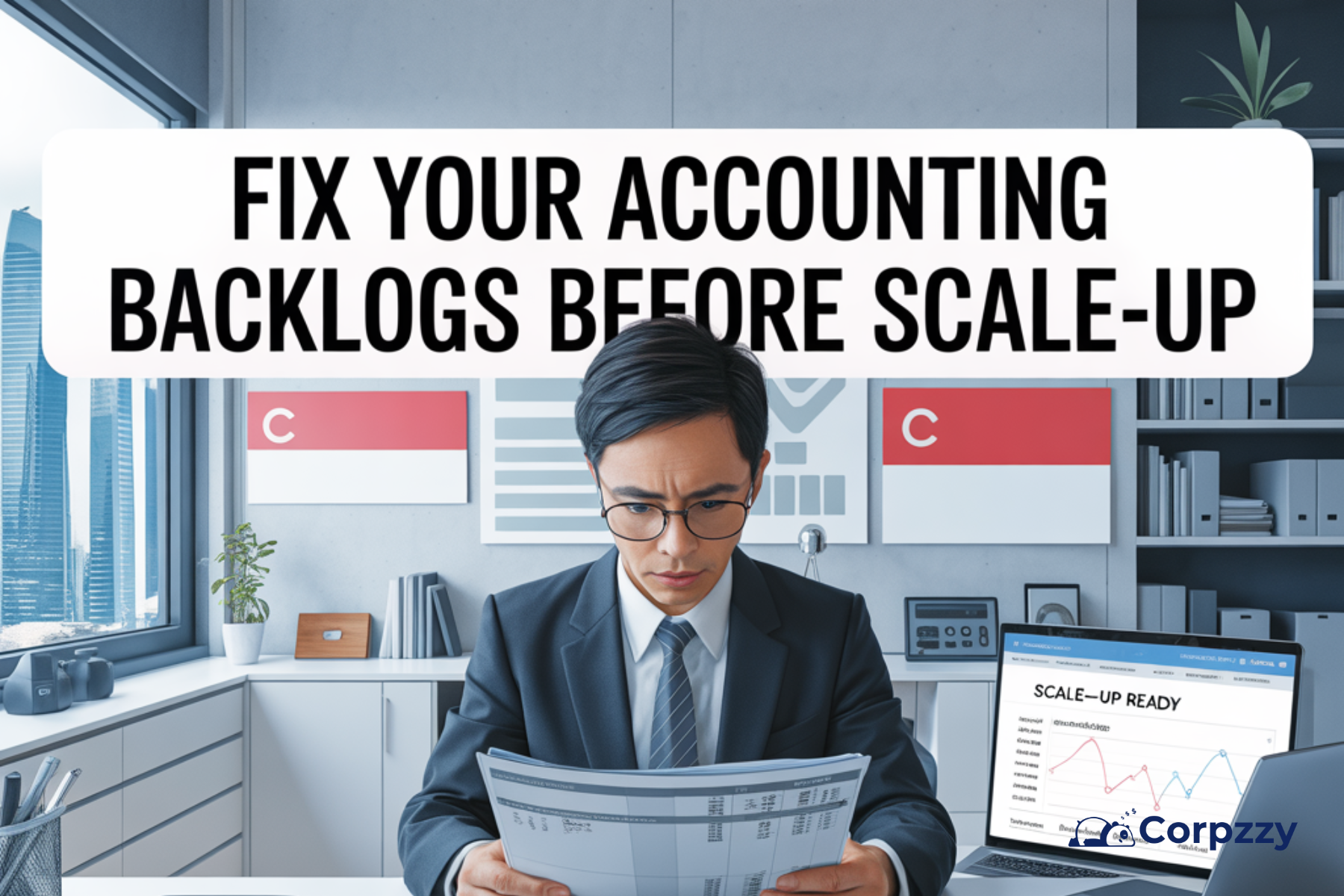
Enterprise Singapore’s Scale-Up Programme is one of the most ambitious transformation initiatives available to Singapore SMEs today. Its purpose is clear: To turn high-potential SMEs into professional, scalable, mid-sized enterprises with strong governance, clear strategy, and the operational maturity to compete regionally.
Unlike grants or subsidies, Scale-Up is not an “application for funding.” It is a deep business transformation exercise that puts your entire company under strategic evaluation — from financial structure to leadership capability, operational processes, and commercial model.
And this is why EnterpriseSG has one requirement many SME owners overlook:
- Before joining Scale-Up, your accounting cannot be messy.
- Before you transform, your financial foundation must be solid.
Backlogs in bookkeeping, incomplete records, “Excel accounting,” or inconsistent financial statements do not just slow the Scale-Up process — they make transformation impossible.
This article will explain the full reasoning behind this requirement and help SME owners understand what they must fix before applying to the Scale-Up Programme in 2025 and beyond.
1. Scale-Up Is a Strategic Transformation Programme — Not a Funding Exercise
Many SME owners mistakenly think Scale-Up is similar to EDG or PSG — where the company applies for a project and receives financial support.
This is nothing like that.
Scale-Up is:
- part business diagnosis
- part leadership development
- part operational overhaul
- part strategic restructuring
- part capability-building
- and part growth planning
The programme includes support from top local and international consulting firms. These consultants rely heavily on accurate financial data to identify:
- profitability issues
- staffing inefficiencies
- operational bottlenecks
- growth constraints
- product-level performance
- cashflow leakage
- mispriced offerings
- financial risks
- expansion feasibility
This strategic work cannot begin if your business lacks clean, complete, and up-to-date accounting.
Without financial clarity, Scale-Up consultants are working blind.
2. Why Messy Accounting Makes You “Not Scale-Up Ready”
Accounting backlogs are not harmless. They are a signal of deeper underlying problems that Scale-Up consultants cannot afford to ignore.
Below are the reasons why EnterpriseSG is strict about financial hygiene.
A. Consultants need accurate numbers to diagnose your business model
The first phase of Scale-Up involves understanding:
- how your business makes money
- which products drive or destroy margin
- whether your cost structure is healthy
- how sustainable your cashflow is
- whether your business can scale without collapsing
- where pricing is hurting profitability
- where inefficiencies occur in operations
This diagnosis is impossible when:
- accounts are behind
- invoices are missing
- numbers don’t match bank statements
- revenue or cost recognition is inconsistent
- expenses are mixed with personal spending
- GST is wrongly applied
- payroll does not match accounting entries
Every transformation recommendation requires a baseline. Without that baseline, no advice can be trusted.
B. Backlogs hide risks that threaten scalability
When Corpzzy cleans up SME accounts, we often uncover:
- unrecorded liabilities
- unpaid vendor balances
- inflated revenue figures
- underreported costs
- tax underpayment
- outdated receivables
- missing payroll adjustments
- undocumented director loans
- duplicated transactions
- inconsistent GST filings
These problems directly affect:
- your true profitability
- your cashflow position
- investor confidence
- banking credibility
- grant eligibility
- business sustainability
EnterpriseSG cannot recommend scaling up a business that does not have a stable financial foundation.
C. Clean accounting reflects strong management discipline
The Scale-Up Programme is not only about business strategy. It is also about leadership capability and organisational maturity.
When EnterpriseSG reviews your accounts, they assess:
- How disciplined is the management team?
- Are financial processes structured or ad hoc?
- Are internal controls strong or weak?
- Is the company prepared for governance-driven scaling?
- Can the leadership team support rapid growth?
Messy accounting is a red flag that suggests:
- ❌ Lack of professionalism
- ❌ Weak management culture
- ❌ Poor documentation habits
- ❌ Siloed operations
- ❌ Reliance on founder intuition instead of data
- ❌ Absence of financial controls
Scale-Up is meant for SMEs ready to professionalise, not those still in firefighting mode.
D. Strategy cannot be built on assumptions
If your financials are inaccurate, even the best consultants cannot:
- build reliable forecasts
- structure a realistic scaling plan
- calculate workforce productivity
- model cost restructuring
- measure revenue quality
- determine expansion viability
- model financing or investment needs
Imagine designing a regional expansion plan based on:
- incorrect margins
- miscalculated overhead
- outdated sales figures
- overstated profits
- or missing expense items
You will outgrow your capacity faster than you can scale it — a recipe for collapse.
EnterpriseSG cannot afford to build strategies on incomplete or incorrect financials.
E. Clean accounting is necessary for future grants & financing
Many Scale-Up participants go on to pursue:
- EDG projects
- MRA grants
- capability development programmes
- venture investment
- bank loans
- regional expansion financing
But if your books are messy:
- auditors delay approval
- banks request additional documentation
- IRAS queries your filings
- EnterpriseSG flags inconsistencies
- investors lose confidence
- grants get rejected
Scale-Up is not an isolated programme. It is meant to prepare SMEs for the next stage of financing and growth.
If your accounting foundation is weak, downstream opportunities collapse.
3. The Hidden Costs of Joining Scale-Up With Bad Accounting
Some SMEs believe:
“We’ll clean up our financials once the consultants come in.”
This is one of the biggest mistakes.
Here’s what actually happens:
1. Consultants use the first 2–3 months just to fix your books
When the strategic team starts discovering:
- unreconciled accounts
- inconsistent categorisation
- missing documentation
- misreported revenue
- outdated statements
They halt strategic work and divert resources to cleaning the books.
You lose strategic months of the programme.
2. The transformation roadmap becomes less accurate
If only 60–70% of your numbers are reliable:
- pricing analysis becomes wrong
- cost structure assessment becomes unreliable
- productivity measurement becomes inaccurate
- growth strategy becomes risky
- margin optimisation is based on false assumptions
The programme becomes guesswork instead of precision.
3. You waste consulting hours on bookkeeping, not transformation
Scale-Up consultants cost thousands of dollars per session. Using them to clean your accounts is:
- ❌ expensive
- ❌ inefficient
- ❌ unnecessary
- ❌ wasteful
This is work that should have been done before applying.
4. Your leadership credibility drops immediately
Consultants and EnterpriseSG advisors will think:
- “This company is not ready.”
- “The founder lacks financial discipline.”
- “There is no internal control.”
- “The team has low governance maturity.”
This perception impacts how the consultants engage with your team.
5. You slow down every operational workstream
Clean accounting affects:
- HR decisions
- digitalisation direction
- pricing structure
- new product planning
- process improvement
- margin restructuring
If the numbers are wrong, every decision becomes delayed.
4. The 2025 EnterpriseSG Shift — Scale-Up is Now More Selective
Since late 2024, EnterpriseSG has been tightening Scale-Up eligibility.
They want SMEs who show:
- ✔️ Financial discipline
- ✔️ Professional management
- ✔️ Clear governance
- ✔️ Strong operational structure
- ✔️ Ability to absorb transformation
- ✔️ Leadership that can execute change
- ✔️ High growth readiness
And they avoid SMEs who:
- ❌ have backlogged accounts
- ❌ lack proper financial controls
- ❌ mix personal and business spending
- ❌ do not produce monthly management accounts
- ❌ rely on year-end financials only
- ❌ cannot answer basic financial questions
This shift reflects Singapore’s broader push to:
- professionalise SMEs
- build regional champions
- strengthen governance
- prepare businesses for succession
- increase productivity
- improve economic resilience
Scale-Up is no longer for SMEs with ambition but weak foundations. It is for SMEs with ambition and proven discipline.
5. Corpzzy’s 4-Step Scale-Up Readiness Framework
Corpzzy helps SMEs prepare before applying to Scale-Up, so the programme becomes strategic — not operational firefighting.
Here is the recommended readiness pathway:
Step 1 — Clear 12–24 Months of Accounting Backlogs
- Your financials must be:
- fully up-to-date
- supported by documentation
- reconciled with bank statements
- categorised properly
- free of duplicated entries
- GST-accurate
- aligned with secretary filings
- compliant with IRAS standards
This is non-negotiable.
Step 2 — Convert to Monthly Management Accounting
EnterpriseSG expects:
- monthly P&L
- monthly balance sheet
- monthly cashflow
- aged AR/AP
- segment revenue
- cost breakdown
- budget vs actual
- financial commentary
This shows you run your business like a professional enterprise.
Step 3 — Strengthen Internal Governance & Documentation
This includes:
- separating owner and company expenses
- building approval workflows
- proper record-keeping
- proper director/shareholder resolutions
- supplier documentation
- payroll alignment
- clean inventory or project costing
EnterpriseSG consultants function best when governance is already in place.
Step 4 — Prepare a “Scale-Up Ready” Financial Pack
This pack typically includes:
- last 2 years financial statements
- monthly management accounts
- cashflow projections
- revenue segment analysis
- margin analysis
- cost restructuring opportunities
- leadership structure overview
- tax compliance status
- governance documentation
Corpzzy prepares this so consultants can begin strategy from Day 1.
6. When Accounting Is Clean, Scale-Up Becomes Transformational
Here is what SMEs experience when their numbers are strong:
- ✔️ Consultants can deliver precise, high-impact recommendations
- ✔️ Financial modelling becomes clear and actionable
- ✔️ Expansion funding becomes easier
- ✔️ Pricing strategy becomes data-driven
- ✔️ Hiring plans become aligned with real needs
- ✔️ Productivity improvements become measurable
- ✔️ Regionalisation becomes realistic
- ✔️ Leadership decisions become faster
Scale-Up is powerful — but only if the foundation is strong.
7. Final Advice for SME Owners
If you plan to join Scale-Up: Do not wait until the programme starts to fix your accounts.
Do it now.
Clean accounting is not about compliance.
- It is about clarity.
- It is about credibility.
- It is about professionalising your business to take the next leap.
Scale-Up transforms businesses – but only if the business is ready for transformation.
Frequently Asked Questions
Questions? We Have Answers
Related Business Articles
Share This Story, Choose Your Platform!

Enterprise Singapore’s Scale-Up Programme is one of the most ambitious transformation initiatives available to Singapore SMEs today. Its purpose is clear: To turn high-potential SMEs into professional, scalable, mid-sized enterprises with strong governance, clear strategy, and the operational maturity to compete regionally.
Unlike grants or subsidies, Scale-Up is not an “application for funding.” It is a deep business transformation exercise that puts your entire company under strategic evaluation — from financial structure to leadership capability, operational processes, and commercial model.
And this is why EnterpriseSG has one requirement many SME owners overlook:
- Before joining Scale-Up, your accounting cannot be messy.
- Before you transform, your financial foundation must be solid.
Backlogs in bookkeeping, incomplete records, “Excel accounting,” or inconsistent financial statements do not just slow the Scale-Up process — they make transformation impossible.
This article will explain the full reasoning behind this requirement and help SME owners understand what they must fix before applying to the Scale-Up Programme in 2025 and beyond.
1. Scale-Up Is a Strategic Transformation Programme — Not a Funding Exercise
Many SME owners mistakenly think Scale-Up is similar to EDG or PSG — where the company applies for a project and receives financial support.
This is nothing like that.
Scale-Up is:
- part business diagnosis
- part leadership development
- part operational overhaul
- part strategic restructuring
- part capability-building
- and part growth planning
The programme includes support from top local and international consulting firms. These consultants rely heavily on accurate financial data to identify:
- profitability issues
- staffing inefficiencies
- operational bottlenecks
- growth constraints
- product-level performance
- cashflow leakage
- mispriced offerings
- financial risks
- expansion feasibility
This strategic work cannot begin if your business lacks clean, complete, and up-to-date accounting.
Without financial clarity, Scale-Up consultants are working blind.
2. Why Messy Accounting Makes You “Not Scale-Up Ready”
Accounting backlogs are not harmless. They are a signal of deeper underlying problems that Scale-Up consultants cannot afford to ignore.
Below are the reasons why EnterpriseSG is strict about financial hygiene.
A. Consultants need accurate numbers to diagnose your business model
The first phase of Scale-Up involves understanding:
- how your business makes money
- which products drive or destroy margin
- whether your cost structure is healthy
- how sustainable your cashflow is
- whether your business can scale without collapsing
- where pricing is hurting profitability
- where inefficiencies occur in operations
This diagnosis is impossible when:
- accounts are behind
- invoices are missing
- numbers don’t match bank statements
- revenue or cost recognition is inconsistent
- expenses are mixed with personal spending
- GST is wrongly applied
- payroll does not match accounting entries
Every transformation recommendation requires a baseline. Without that baseline, no advice can be trusted.
B. Backlogs hide risks that threaten scalability
When Corpzzy cleans up SME accounts, we often uncover:
- unrecorded liabilities
- unpaid vendor balances
- inflated revenue figures
- underreported costs
- tax underpayment
- outdated receivables
- missing payroll adjustments
- undocumented director loans
- duplicated transactions
- inconsistent GST filings
These problems directly affect:
- your true profitability
- your cashflow position
- investor confidence
- banking credibility
- grant eligibility
- business sustainability
EnterpriseSG cannot recommend scaling up a business that does not have a stable financial foundation.
C. Clean accounting reflects strong management discipline
The Scale-Up Programme is not only about business strategy. It is also about leadership capability and organisational maturity.
When EnterpriseSG reviews your accounts, they assess:
- How disciplined is the management team?
- Are financial processes structured or ad hoc?
- Are internal controls strong or weak?
- Is the company prepared for governance-driven scaling?
- Can the leadership team support rapid growth?
Messy accounting is a red flag that suggests:
- ❌ Lack of professionalism
- ❌ Weak management culture
- ❌ Poor documentation habits
- ❌ Siloed operations
- ❌ Reliance on founder intuition instead of data
- ❌ Absence of financial controls
Scale-Up is meant for SMEs ready to professionalise, not those still in firefighting mode.
D. Strategy cannot be built on assumptions
If your financials are inaccurate, even the best consultants cannot:
- build reliable forecasts
- structure a realistic scaling plan
- calculate workforce productivity
- model cost restructuring
- measure revenue quality
- determine expansion viability
- model financing or investment needs
Imagine designing a regional expansion plan based on:
- incorrect margins
- miscalculated overhead
- outdated sales figures
- overstated profits
- or missing expense items
You will outgrow your capacity faster than you can scale it — a recipe for collapse.
EnterpriseSG cannot afford to build strategies on incomplete or incorrect financials.
E. Clean accounting is necessary for future grants & financing
Many Scale-Up participants go on to pursue:
- EDG projects
- MRA grants
- capability development programmes
- venture investment
- bank loans
- regional expansion financing
But if your books are messy:
- auditors delay approval
- banks request additional documentation
- IRAS queries your filings
- EnterpriseSG flags inconsistencies
- investors lose confidence
- grants get rejected
Scale-Up is not an isolated programme. It is meant to prepare SMEs for the next stage of financing and growth.
If your accounting foundation is weak, downstream opportunities collapse.
3. The Hidden Costs of Joining Scale-Up With Bad Accounting
Some SMEs believe:
“We’ll clean up our financials once the consultants come in.”
This is one of the biggest mistakes.
Here’s what actually happens:
1. Consultants use the first 2–3 months just to fix your books
When the strategic team starts discovering:
- unreconciled accounts
- inconsistent categorisation
- missing documentation
- misreported revenue
- outdated statements
They halt strategic work and divert resources to cleaning the books.
You lose strategic months of the programme.
2. The transformation roadmap becomes less accurate
If only 60–70% of your numbers are reliable:
- pricing analysis becomes wrong
- cost structure assessment becomes unreliable
- productivity measurement becomes inaccurate
- growth strategy becomes risky
- margin optimisation is based on false assumptions
The programme becomes guesswork instead of precision.
3. You waste consulting hours on bookkeeping, not transformation
Scale-Up consultants cost thousands of dollars per session. Using them to clean your accounts is:
- ❌ expensive
- ❌ inefficient
- ❌ unnecessary
- ❌ wasteful
This is work that should have been done before applying.
4. Your leadership credibility drops immediately
Consultants and EnterpriseSG advisors will think:
- “This company is not ready.”
- “The founder lacks financial discipline.”
- “There is no internal control.”
- “The team has low governance maturity.”
This perception impacts how the consultants engage with your team.
5. You slow down every operational workstream
Clean accounting affects:
- HR decisions
- digitalisation direction
- pricing structure
- new product planning
- process improvement
- margin restructuring
If the numbers are wrong, every decision becomes delayed.
4. The 2025 EnterpriseSG Shift — Scale-Up is Now More Selective
Since late 2024, EnterpriseSG has been tightening Scale-Up eligibility.
They want SMEs who show:
- ✔️ Financial discipline
- ✔️ Professional management
- ✔️ Clear governance
- ✔️ Strong operational structure
- ✔️ Ability to absorb transformation
- ✔️ Leadership that can execute change
- ✔️ High growth readiness
And they avoid SMEs who:
- ❌ have backlogged accounts
- ❌ lack proper financial controls
- ❌ mix personal and business spending
- ❌ do not produce monthly management accounts
- ❌ rely on year-end financials only
- ❌ cannot answer basic financial questions
This shift reflects Singapore’s broader push to:
- professionalise SMEs
- build regional champions
- strengthen governance
- prepare businesses for succession
- increase productivity
- improve economic resilience
Scale-Up is no longer for SMEs with ambition but weak foundations. It is for SMEs with ambition and proven discipline.
5. Corpzzy’s 4-Step Scale-Up Readiness Framework
Corpzzy helps SMEs prepare before applying to Scale-Up, so the programme becomes strategic — not operational firefighting.
Here is the recommended readiness pathway:
Step 1 — Clear 12–24 Months of Accounting Backlogs
- Your financials must be:
- fully up-to-date
- supported by documentation
- reconciled with bank statements
- categorised properly
- free of duplicated entries
- GST-accurate
- aligned with secretary filings
- compliant with IRAS standards
This is non-negotiable.
Step 2 — Convert to Monthly Management Accounting
EnterpriseSG expects:
- monthly P&L
- monthly balance sheet
- monthly cashflow
- aged AR/AP
- segment revenue
- cost breakdown
- budget vs actual
- financial commentary
This shows you run your business like a professional enterprise.
Step 3 — Strengthen Internal Governance & Documentation
This includes:
- separating owner and company expenses
- building approval workflows
- proper record-keeping
- proper director/shareholder resolutions
- supplier documentation
- payroll alignment
- clean inventory or project costing
EnterpriseSG consultants function best when governance is already in place.
Step 4 — Prepare a “Scale-Up Ready” Financial Pack
This pack typically includes:
- last 2 years financial statements
- monthly management accounts
- cashflow projections
- revenue segment analysis
- margin analysis
- cost restructuring opportunities
- leadership structure overview
- tax compliance status
- governance documentation
Corpzzy prepares this so consultants can begin strategy from Day 1.
6. When Accounting Is Clean, Scale-Up Becomes Transformational
Here is what SMEs experience when their numbers are strong:
- ✔️ Consultants can deliver precise, high-impact recommendations
- ✔️ Financial modelling becomes clear and actionable
- ✔️ Expansion funding becomes easier
- ✔️ Pricing strategy becomes data-driven
- ✔️ Hiring plans become aligned with real needs
- ✔️ Productivity improvements become measurable
- ✔️ Regionalisation becomes realistic
- ✔️ Leadership decisions become faster
Scale-Up is powerful — but only if the foundation is strong.
7. Final Advice for SME Owners
If you plan to join Scale-Up: Do not wait until the programme starts to fix your accounts.
Do it now.
Clean accounting is not about compliance.
- It is about clarity.
- It is about credibility.
- It is about professionalising your business to take the next leap.
Scale-Up transforms businesses – but only if the business is ready for transformation.
Frequently Asked Questions
Questions? We Have Answers
Share This Story, Choose Your Platform!