
IRAS Is Rejecting More EIS Claims: What SMEs Must Do Differently in 2025
IRAS Is Rejecting More EIS Claims: What SMEs Must Do Differently in 2025
Outline
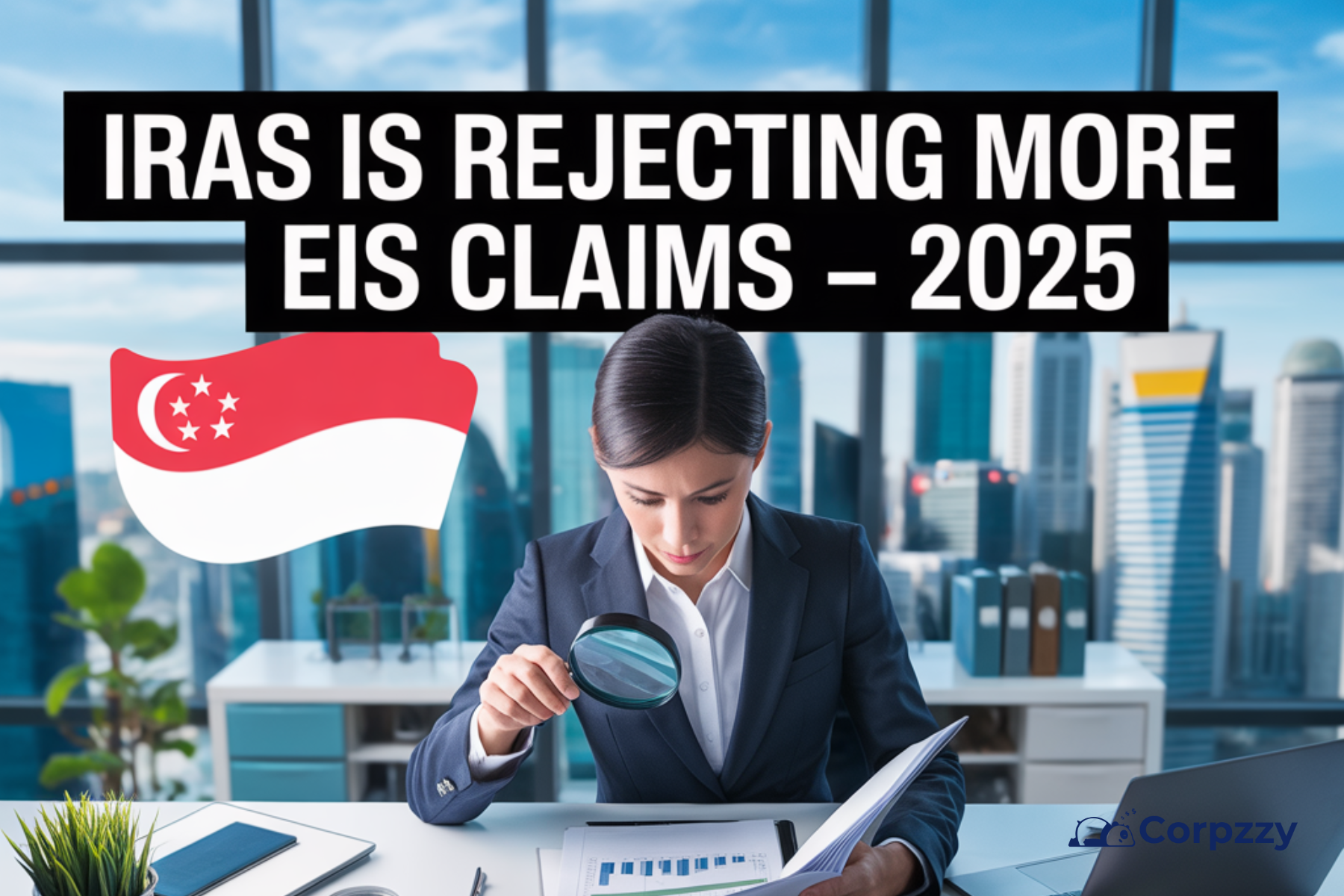
Singapore’s Enterprise Innovation Scheme (EIS) was created with a clear purpose: Encourage SMEs to innovate, upskill, digitalise, and develop IP — not just survive.
But from late 2023 onwards, IRAS quietly tightened its review and audit standards after detecting:
- Overstated R&D costs
- Training expenses that don’t qualify
- Outdated or duplicated invoices
- Projects that lack evidence of innovation
- SMEs inflating claims without documentation
- Vendors selling “EIS-ready packages” that don’t satisfy the law
As a result, EIS rejection rates jumped significantly in 2024, and 2025 will be even stricter. IRAS wants real innovation, not opportunistic tax claims.
For Singapore SMEs, this means one thing:
EIS is no longer a fast-track grant. It is a high-scrutiny compliance exercise — and you must treat it like one.
Corpzzy’s role is to help SMEs reduce risk, keep documentation clean, and stay compliant without stress. This article explains what changed, why claims are being rejected, and what SMEs must do differently in 2025.
1. Why IRAS Is Rejecting More EIS Claims
A. Abuse and over-claiming surged during 2023–2024
When EIS was launched, many SMEs filed claims without understanding what “innovation” legally means.
Some common mistakes:
- Claiming standard app development as R&D
- Claiming online courses as “specialised training”
- Claiming software subscriptions with no link to innovation
- Claiming marketing costs
- Claiming routine IT work like “troubleshooting,” “website updates,” or “UI enhancement”
IRAS picked up these patterns quickly.
B. Vendors oversold “EIS-ready” services
Some service providers promised:
❌ “Guaranteed EIS rebates”
❌ “Pre-approved training”
❌ “We create an EIS project for you”
IRAS does NOT have such concepts.
Many SMEs unknowingly submitted high-risk claims based on vendor marketing.
C. Documentation was extremely weak
The most common reason for rejection:
SMEs cannot demonstrate how the expenses contributed to innovation.
IRAS wants proof of:
- Research
- Design
- Testing
- Technical uncertainties
- Commercialisation plan
- IP creation
Most SMEs submitted:
- An invoice
- A generic project summary
- A website quote
This is not enough.
D. IRAS is now using machine-learning audit filters
Many don’t know this — but IRAS introduced new consistency-check systems:
- Comparing claims across industries
- Detecting “template descriptions”
- Checking economic substance
- Flagging suspicious vendor patterns
- Reviewing year-to-year innovation patterns
- Matching invoices with GST submissions
If anything looks inconsistent, the claim is flagged or rejected immediately.
E. EIS cash payout abuse triggered deeper controls
SMEs claiming the cash payout option (instead of enhanced deductions) saw the highest rejection rates.
Why?
Because cash payouts attract abuse — especially when:
- There’s no proof of innovation
- Costs are inflated
- Vendors are unaccredited
- There is no internal project documentation
IRAS tightened the payout checks significantly.
2. What IRAS Will Scrutinise More Heavily in 2025
2025 IRAS guidelines focus on three big areas: the project, the vendor, and the documentation.
A. Project Criteria — “Innovation” Must Be Real, Not Cosmetic
IRAS will look for clear evidence of:
1. A real innovation challenge
This could be:
- A technical challenge
- A process inefficiency
- A product development need
- A digitalisation gap
- A research requirement
Innovation must involve uncertainty, not routine work.
2. Actual development work
Including:
- Prototyping
- Data modelling
- Experimentation
- Technical testing
- Iteration and refinement
- User testing tied to innovation pathways
Building a simple website or mobile app no longer qualifies unless there’s technical innovation.
3. Clear commercial intent
IRAS wants to see:
- Market need analysis
- Target users
- How the innovation impacts operations
- Measurable value
- Path to adoption
A project used for branding or sales typically does NOT qualify.
B. Vendor Criteria — IRAS Will Now Evaluate the Credibility of Your Provider
From 2025, IRAS is checking:
- Vendor experience
- Vendor track record
- Nature of the vendor business
- Whether the vendor is GST-registered
- Repeated EIS claims across suspicious vendors
- Vendors who issue identical invoices to many SMEs
If your vendor looks like a “EIS farm,” your claim is at risk.
C. Documentation Criteria — The Biggest Cause of Rejections
In 2025, IRAS expects SMEs to maintain at least:
✔️ Problem statements
What problem you aimed to solve, why it matters, and why existing solutions are insufficient.
✔️ Technical approach
Clear description of experimentation, R&D, testing, or innovation process.
✔️ Project records
- Progress reports
- Design drafts
- Screenshots
- Code snippets
- Testing logs
- Meeting notes
✔️ Evidence of work performed
To show the vendor actually completed the project.
✔️ Invoices with detailed breakdowns
Not a single line item such as: “Innovation Project – $50,000”
✔️ Proof of payment
Bank transfers, not cash.
Documentation is EVERYTHING under EIS. Without it, IRAS can — and will — reject your claim.
3. The Most Common EIS Mistakes SMEs Make
These errors appear across hundreds of rejected submissions:
1. “Claiming first, documenting later”
Many SMEs created documents after IRAS queried them. IRAS can detect this easily — through metadata, timestamps, and project inconsistency.
2. Treating digitalisation as innovation
Digitalisation ≠ Innovation.
Examples that do not qualify:
- Building a standard Shopify site
- Buying a CRM
- Cloud migration
- Updating UI/UX
- Simple automation
Innovative work must go beyond standard vendor services.
3. Training that IRAS does not recognise
SMEs often claim:
- Generic online courses
- Self-paced modules
- Productivity workshops
- Marketing training
- Sales training
EIS training requires accredited providers and highly technical, innovation-related content.
4. Inflated or lump-sum invoices
SMEs often claim:
- S$50,000 “innovation project”
- S$30,000 “system revamp”
- S$80,000 “R&D work”
IRAS treats these as high-risk if:
- There’s no cost breakdown
- Hours of work not documented
- Vendor cannot substantiate the deliverables
5. Using unofficial or unlicensed vendors
Many SMEs unknowingly worked with:
- Overseas freelancers
- Non-registered businesses
- Nominee companies
- Marketing agencies
- Training providers with no accreditation
IRAS rejects these claims instantly.
4. What SMEs Must Do Differently in 2025
This is where most SMEs struggle — because EIS is not a one-time filing. It requires a proper compliance workflow.
Here’s the 2025 playbook.
A. Start documenting BEFORE the project begins
Document the following at project kick-off:
- The problem statement
- Why innovation is required
- What research was done
- What uncertainties exist
- Expected outcomes
This shows IRAS the project is genuine — not retrofitted.
B. Build an “Innovation Folder” with all evidence
Corpzzy recommends every SME create a single folder containing:
- Vendor proposals
- Technical notes
- Design drafts
- Meeting minutes
- Screenshots
- Testing logs
- Prototype versions
- Payment records
- Progress reports
This is your defence file in case IRAS audits.
C. Choose vendors with strong innovation capabilities
Avoid vendors who:
- ❌ Offer “guaranteed EIS approval”
- ❌ Provide template documents
- ❌ Cannot explain their innovation methodology
- ❌ Have no technical personnel
Choose vendors who can:
- ✔️ Provide breakdowns
- ✔️ Demonstrate R&D work
- ✔️ Produce documentation
- ✔️ Explain technical decisions
Vendor credibility is now a core audit factor.
D. Keep accounting, secretary & IRAS filings aligned
This is where SMEs often fail.
IRAS may compare:
- EIS invoice amounts vs accounting treatment
- Cash payouts vs bank transfers
- Vendor classification vs financial statements
- IP development vs corporate secretary documentation (e.g., shareholding, director approval)
- GST treatment vs EIS claim
If your filings don’t align, IRAS rejects the claim immediately.
This is why many SMEs now consolidate:
Accounting + Tax + Secretary + EIS advisory under one provider like Corpzzy.
You remove inconsistencies and avoid avoidable rejections.
E. Never submit EIS claims “blindly”
Before filing, SMEs must run a checklist:
- ✔️ Is the project truly innovative?
- ✔️ Are all deliverables documented?
- ✔️ Do invoices have detailed breakdowns?
- ✔️ Does the vendor have credibility?
- ✔️ Are payments traceable and legitimate?
- ✔️ Do accounting records match the claim?
- ✔️ Is training from a recognised provider?
If any item above fails, your EIS claim is at risk.
5. The New 2025 IRAS Audit Pattern: What They Are Likely to Request
If IRAS queries your claim, they may ask for:
1. Project documentation
- Research notes
- Technical problems
- Screenshots
- Coding work
- Drawings and prototypes
2. Vendor evidence
- Project breakdown
- Timesheets
- Work logs
- Technical justifications
3. Accounting evidence
- Payment proof
- Bank statements
- Bookkeeping records
- Matching GST filings
4. Corporate authorisations
- Director approval
- Contract agreements
Most SMEs cannot produce these on their own — because the documentation was never created. This is why many EIS claims get rejected, even when they were legitimate.
6. What Happens When Your EIS Claim Is Rejected?
The consequences are more serious than most SMEs realise.
A. Loss of cash payout or tax deduction
This disrupts cashflow and your tax strategy.
B. IRAS may conduct deeper audits
Which may extend into:
- GST
- Corporate tax
- Past EIS claims
- Transfer pricing (for larger SMEs)
C. SME reputation is affected
Future claims will receive more scrutiny.
D. Potential penalties
For severe or repeated non-compliance.
E. Vendors may refuse to support post-facto documentation
Leaving SMEs stuck.
7. How Corpzzy Helps SMEs Protect Their EIS Claims
At Corpzzy, our service philosophy is simple:
Clarity, predictability, and compliance protection — without the overwhelm.
We help SMEs by:
A. Validating whether your project truly qualifies
Before you waste time and resources.
B. Reviewing vendor deliverables & documentation
To ensure it meets IRAS standards.
C. Creating a structured “Innovation Evidence File”
So your claim is defensible even during audits.
D. Aligning accounting, tax, and secretary documentation
Fixing inconsistencies before filing.
E. Helping prepare EIS schedules, breakdowns, and narratives
These are crucial for IRAS reviewers.
F. Filing accurately and safely
Avoiding mistakes that trigger audit flags.
G. Supporting you during IRAS queries
We help prepare responses logically and professionally.
8. Final Advice for Singapore SMEs in 2025
The EIS is one of the most powerful tax incentives Singapore has ever offered — but IRAS wants quality, not quantity.
To avoid rejection:
- Choose credible vendors
- Document everything
- Avoid inflated invoices
- Work with a compliance-driven partner
- Ensure accounting, payroll, secretary, and tax filings align
- Treat EIS as a serious compliance process, not a shortcut
SMEs who ignore these rules will face rising rejection rates. SMEs who adapt will enjoy:
- Stronger tax deductions
- Smoother IRAS interactions
- Lower audit risk
- Better innovation discipline
- More predictable cashflow
2025 is the year where EIS claims must be done properly. Corpzzy is here to make that process simple, clear, and compliant for you.
Frequently Asked Questions
Questions? We Have Answers
Related Business Articles
Share This Story, Choose Your Platform!

Singapore’s Enterprise Innovation Scheme (EIS) was created with a clear purpose: Encourage SMEs to innovate, upskill, digitalise, and develop IP — not just survive.
But from late 2023 onwards, IRAS quietly tightened its review and audit standards after detecting:
- Overstated R&D costs
- Training expenses that don’t qualify
- Outdated or duplicated invoices
- Projects that lack evidence of innovation
- SMEs inflating claims without documentation
- Vendors selling “EIS-ready packages” that don’t satisfy the law
As a result, EIS rejection rates jumped significantly in 2024, and 2025 will be even stricter. IRAS wants real innovation, not opportunistic tax claims.
For Singapore SMEs, this means one thing:
EIS is no longer a fast-track grant. It is a high-scrutiny compliance exercise — and you must treat it like one.
Corpzzy’s role is to help SMEs reduce risk, keep documentation clean, and stay compliant without stress. This article explains what changed, why claims are being rejected, and what SMEs must do differently in 2025.
1. Why IRAS Is Rejecting More EIS Claims
A. Abuse and over-claiming surged during 2023–2024
When EIS was launched, many SMEs filed claims without understanding what “innovation” legally means.
Some common mistakes:
- Claiming standard app development as R&D
- Claiming online courses as “specialised training”
- Claiming software subscriptions with no link to innovation
- Claiming marketing costs
- Claiming routine IT work like “troubleshooting,” “website updates,” or “UI enhancement”
IRAS picked up these patterns quickly.
B. Vendors oversold “EIS-ready” services
Some service providers promised:
❌ “Guaranteed EIS rebates”
❌ “Pre-approved training”
❌ “We create an EIS project for you”
IRAS does NOT have such concepts.
Many SMEs unknowingly submitted high-risk claims based on vendor marketing.
C. Documentation was extremely weak
The most common reason for rejection:
SMEs cannot demonstrate how the expenses contributed to innovation.
IRAS wants proof of:
- Research
- Design
- Testing
- Technical uncertainties
- Commercialisation plan
- IP creation
Most SMEs submitted:
- An invoice
- A generic project summary
- A website quote
This is not enough.
D. IRAS is now using machine-learning audit filters
Many don’t know this — but IRAS introduced new consistency-check systems:
- Comparing claims across industries
- Detecting “template descriptions”
- Checking economic substance
- Flagging suspicious vendor patterns
- Reviewing year-to-year innovation patterns
- Matching invoices with GST submissions
If anything looks inconsistent, the claim is flagged or rejected immediately.
E. EIS cash payout abuse triggered deeper controls
SMEs claiming the cash payout option (instead of enhanced deductions) saw the highest rejection rates.
Why?
Because cash payouts attract abuse — especially when:
- There’s no proof of innovation
- Costs are inflated
- Vendors are unaccredited
- There is no internal project documentation
IRAS tightened the payout checks significantly.
2. What IRAS Will Scrutinise More Heavily in 2025
2025 IRAS guidelines focus on three big areas: the project, the vendor, and the documentation.
A. Project Criteria — “Innovation” Must Be Real, Not Cosmetic
IRAS will look for clear evidence of:
1. A real innovation challenge
This could be:
- A technical challenge
- A process inefficiency
- A product development need
- A digitalisation gap
- A research requirement
Innovation must involve uncertainty, not routine work.
2. Actual development work
Including:
- Prototyping
- Data modelling
- Experimentation
- Technical testing
- Iteration and refinement
- User testing tied to innovation pathways
Building a simple website or mobile app no longer qualifies unless there’s technical innovation.
3. Clear commercial intent
IRAS wants to see:
- Market need analysis
- Target users
- How the innovation impacts operations
- Measurable value
- Path to adoption
A project used for branding or sales typically does NOT qualify.
B. Vendor Criteria — IRAS Will Now Evaluate the Credibility of Your Provider
From 2025, IRAS is checking:
- Vendor experience
- Vendor track record
- Nature of the vendor business
- Whether the vendor is GST-registered
- Repeated EIS claims across suspicious vendors
- Vendors who issue identical invoices to many SMEs
If your vendor looks like a “EIS farm,” your claim is at risk.
C. Documentation Criteria — The Biggest Cause of Rejections
In 2025, IRAS expects SMEs to maintain at least:
✔️ Problem statements
What problem you aimed to solve, why it matters, and why existing solutions are insufficient.
✔️ Technical approach
Clear description of experimentation, R&D, testing, or innovation process.
✔️ Project records
- Progress reports
- Design drafts
- Screenshots
- Code snippets
- Testing logs
- Meeting notes
✔️ Evidence of work performed
To show the vendor actually completed the project.
✔️ Invoices with detailed breakdowns
Not a single line item such as: “Innovation Project – $50,000”
✔️ Proof of payment
Bank transfers, not cash.
Documentation is EVERYTHING under EIS. Without it, IRAS can — and will — reject your claim.
3. The Most Common EIS Mistakes SMEs Make
These errors appear across hundreds of rejected submissions:
1. “Claiming first, documenting later”
Many SMEs created documents after IRAS queried them. IRAS can detect this easily — through metadata, timestamps, and project inconsistency.
2. Treating digitalisation as innovation
Digitalisation ≠ Innovation.
Examples that do not qualify:
- Building a standard Shopify site
- Buying a CRM
- Cloud migration
- Updating UI/UX
- Simple automation
Innovative work must go beyond standard vendor services.
3. Training that IRAS does not recognise
SMEs often claim:
- Generic online courses
- Self-paced modules
- Productivity workshops
- Marketing training
- Sales training
EIS training requires accredited providers and highly technical, innovation-related content.
4. Inflated or lump-sum invoices
SMEs often claim:
- S$50,000 “innovation project”
- S$30,000 “system revamp”
- S$80,000 “R&D work”
IRAS treats these as high-risk if:
- There’s no cost breakdown
- Hours of work not documented
- Vendor cannot substantiate the deliverables
5. Using unofficial or unlicensed vendors
Many SMEs unknowingly worked with:
- Overseas freelancers
- Non-registered businesses
- Nominee companies
- Marketing agencies
- Training providers with no accreditation
IRAS rejects these claims instantly.
4. What SMEs Must Do Differently in 2025
This is where most SMEs struggle — because EIS is not a one-time filing. It requires a proper compliance workflow.
Here’s the 2025 playbook.
A. Start documenting BEFORE the project begins
Document the following at project kick-off:
- The problem statement
- Why innovation is required
- What research was done
- What uncertainties exist
- Expected outcomes
This shows IRAS the project is genuine — not retrofitted.
B. Build an “Innovation Folder” with all evidence
Corpzzy recommends every SME create a single folder containing:
- Vendor proposals
- Technical notes
- Design drafts
- Meeting minutes
- Screenshots
- Testing logs
- Prototype versions
- Payment records
- Progress reports
This is your defence file in case IRAS audits.
C. Choose vendors with strong innovation capabilities
Avoid vendors who:
- ❌ Offer “guaranteed EIS approval”
- ❌ Provide template documents
- ❌ Cannot explain their innovation methodology
- ❌ Have no technical personnel
Choose vendors who can:
- ✔️ Provide breakdowns
- ✔️ Demonstrate R&D work
- ✔️ Produce documentation
- ✔️ Explain technical decisions
Vendor credibility is now a core audit factor.
D. Keep accounting, secretary & IRAS filings aligned
This is where SMEs often fail.
IRAS may compare:
- EIS invoice amounts vs accounting treatment
- Cash payouts vs bank transfers
- Vendor classification vs financial statements
- IP development vs corporate secretary documentation (e.g., shareholding, director approval)
- GST treatment vs EIS claim
If your filings don’t align, IRAS rejects the claim immediately.
This is why many SMEs now consolidate:
Accounting + Tax + Secretary + EIS advisory under one provider like Corpzzy.
You remove inconsistencies and avoid avoidable rejections.
E. Never submit EIS claims “blindly”
Before filing, SMEs must run a checklist:
- ✔️ Is the project truly innovative?
- ✔️ Are all deliverables documented?
- ✔️ Do invoices have detailed breakdowns?
- ✔️ Does the vendor have credibility?
- ✔️ Are payments traceable and legitimate?
- ✔️ Do accounting records match the claim?
- ✔️ Is training from a recognised provider?
If any item above fails, your EIS claim is at risk.
5. The New 2025 IRAS Audit Pattern: What They Are Likely to Request
If IRAS queries your claim, they may ask for:
1. Project documentation
- Research notes
- Technical problems
- Screenshots
- Coding work
- Drawings and prototypes
2. Vendor evidence
- Project breakdown
- Timesheets
- Work logs
- Technical justifications
3. Accounting evidence
- Payment proof
- Bank statements
- Bookkeeping records
- Matching GST filings
4. Corporate authorisations
- Director approval
- Contract agreements
Most SMEs cannot produce these on their own — because the documentation was never created. This is why many EIS claims get rejected, even when they were legitimate.
6. What Happens When Your EIS Claim Is Rejected?
The consequences are more serious than most SMEs realise.
A. Loss of cash payout or tax deduction
This disrupts cashflow and your tax strategy.
B. IRAS may conduct deeper audits
Which may extend into:
- GST
- Corporate tax
- Past EIS claims
- Transfer pricing (for larger SMEs)
C. SME reputation is affected
Future claims will receive more scrutiny.
D. Potential penalties
For severe or repeated non-compliance.
E. Vendors may refuse to support post-facto documentation
Leaving SMEs stuck.
7. How Corpzzy Helps SMEs Protect Their EIS Claims
At Corpzzy, our service philosophy is simple:
Clarity, predictability, and compliance protection — without the overwhelm.
We help SMEs by:
A. Validating whether your project truly qualifies
Before you waste time and resources.
B. Reviewing vendor deliverables & documentation
To ensure it meets IRAS standards.
C. Creating a structured “Innovation Evidence File”
So your claim is defensible even during audits.
D. Aligning accounting, tax, and secretary documentation
Fixing inconsistencies before filing.
E. Helping prepare EIS schedules, breakdowns, and narratives
These are crucial for IRAS reviewers.
F. Filing accurately and safely
Avoiding mistakes that trigger audit flags.
G. Supporting you during IRAS queries
We help prepare responses logically and professionally.
8. Final Advice for Singapore SMEs in 2025
The EIS is one of the most powerful tax incentives Singapore has ever offered — but IRAS wants quality, not quantity.
To avoid rejection:
- Choose credible vendors
- Document everything
- Avoid inflated invoices
- Work with a compliance-driven partner
- Ensure accounting, payroll, secretary, and tax filings align
- Treat EIS as a serious compliance process, not a shortcut
SMEs who ignore these rules will face rising rejection rates. SMEs who adapt will enjoy:
- Stronger tax deductions
- Smoother IRAS interactions
- Lower audit risk
- Better innovation discipline
- More predictable cashflow
2025 is the year where EIS claims must be done properly. Corpzzy is here to make that process simple, clear, and compliant for you.
Frequently Asked Questions
Questions? We Have Answers
Share This Story, Choose Your Platform!